
Cookieless Conversion Tracking for SEO: How It Works
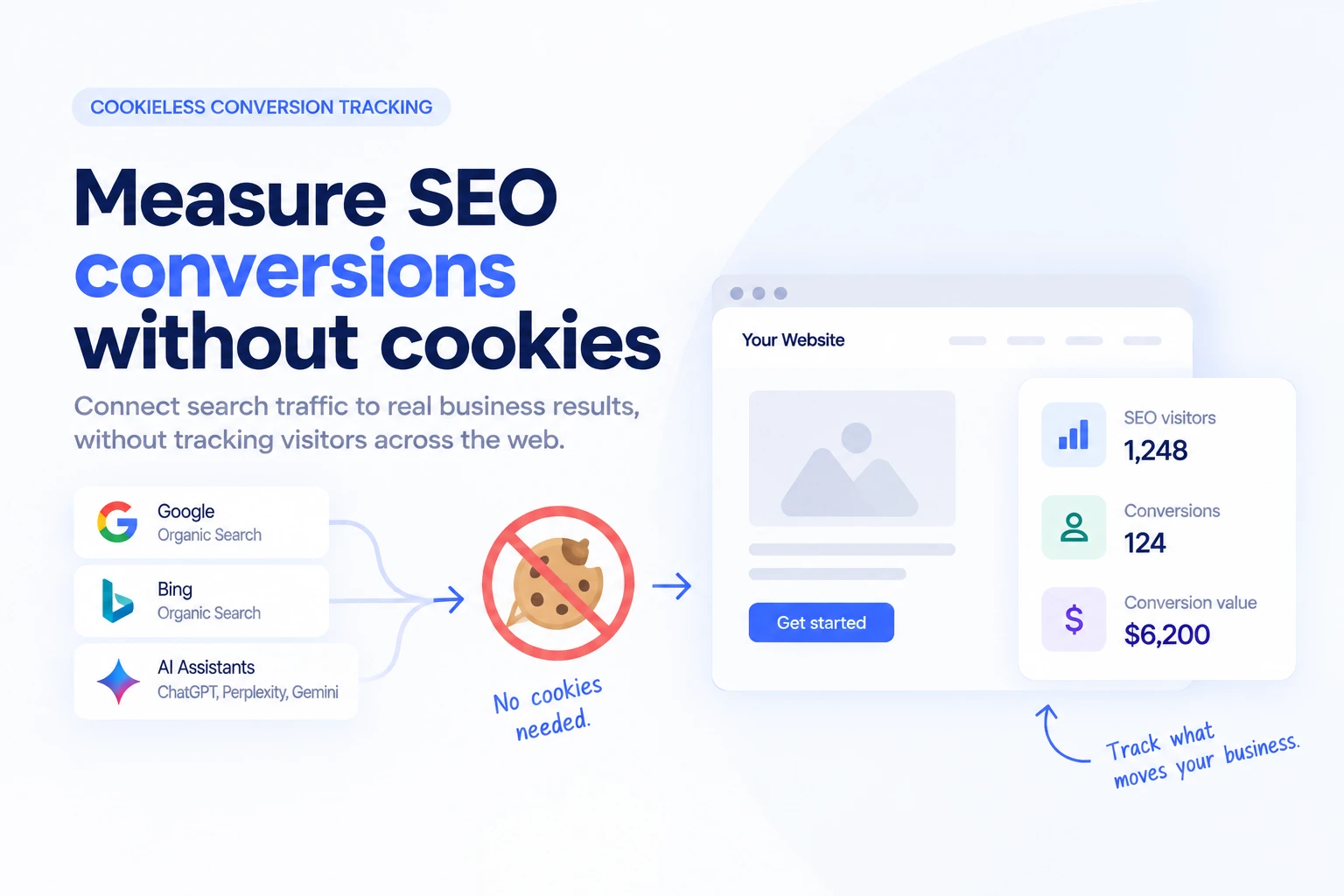
Conversion tracking has traditionally been associated with cookies. A visitor arrives, a cookie stores information about the visit, and that information helps analytics or advertising tools recognize the visitor later.
That model is useful for many types of measurement, but it isn’t the only way to understand whether search traffic converts.
If your main goal is to measure what happens during a visit from Google, Bing or another identifiable search source, you can track meaningful actions without creating a persistent profile of the visitor. That’s where cookieless conversion tracking comes in.
Cookieless conversion tracking measures conversions without storing a persistent identifier in the visitor’s browser. Instead of relying on a cookie to recognize someone across visits, it can use information available during the current visit or session to connect a traffic source, landing page and conversion.
For SEO, that means you can answer questions such as which search channel generated a conversion, which landing page was associated with it and what that conversion was worth, without needing to recognize the same person across multiple visits.
The tradeoff is important: cookieless tracking can measure a lot, but it cannot recreate every cross session customer journey.
What Is Cookieless Conversion Tracking?
Cookieless conversion tracking is a way to measure actions on a website without placing a persistent tracking cookie on the visitor’s device.
A traditional analytics setup may assign an identifier to a browser and store it in a cookie. When the same browser returns later, that identifier can help connect multiple visits to the same user.
Cookieless tracking takes a different approach. It can measure information that is available as the visit happens, such as the traffic source, landing page, page views and conversion events, without relying on a persistent browser identifier to recognize that person later.
For SEO teams, that can be enough to answer many of the questions that matter most.
Did this session come from Organic Search?
Which page did the visitor land on?
Did a signup, purchase, lead or another meaningful conversion happen?
What value was associated with that conversion?
You don’t necessarily need to know who the person was or what they did three weeks ago to answer those questions.
How Does Cookieless Tracking Work?
The exact implementation depends on the tracking system, so “cookieless” doesn’t describe one universal technical method.
At a high level, the important difference is that measurement doesn’t depend on a persistent cookie stored in the browser.
Imagine someone searches Google, clicks your result and lands on /pricing.
During that visit, your analytics setup can receive information about the page, the source of the visit and events that occur afterwards. If the visitor signs up during the same session, the signup can be associated with that search visit.
The basic measurement flow becomes:
rather than:
The first model is narrower, but that can be exactly what an SEO team needs when the goal is to understand direct conversion outcomes from search traffic.
What Can You Track Without Cookies?
No cookies doesn’t mean no analytics.
A cookieless setup can still measure a considerable amount of useful information during a visit, based on how the tool is implemented.
For SEO reporting, this can include traffic sources, landing pages, page views, conversion events, conversion rates, transaction values and estimated conversion values.
Suppose an organic visitor lands on a product page and purchases a $150 product during that visit. You don’t need to recognize that visitor next month to know that the current search session resulted in a $150 transaction.
The same principle applies to non purchase conversions. If an organic visitor submits a demo request, that action can be recorded as a conversion and associated with the current search session.
If the business has determined that a demo request has an estimated value of $50, the conversion can also carry that value.
This is enough to move SEO reporting beyond rankings and traffic without requiring persistent user identification.
For the broader measurement framework, see SEO Conversion Tracking: Measure Conversions and Value from Organic Search.
What Can’t Cookieless Conversion Tracking Tell You?
This is where the distinction becomes important.
Cookieless tracking isn’t a way to obtain all the benefits of persistent user tracking without actually tracking users persistently.
If a visitor arrives through Google today, leaves without converting and returns several days later through another channel, a purely cookieless setup may not be able to recognize those two visits as the same person.
That affects questions such as:
Did this person discover us through SEO before converting later?
How many sessions did they have before becoming a customer?
Which sequence of channels influenced the conversion?
Is this returning browser the same visitor we saw last week?
Those questions require some way to connect activity across visits. If your measurement deliberately avoids persistent identifiers, that continuity is limited by design.
This is one of the main tradeoffs of cookieless analytics, and it shouldn’t be hidden behind a privacy claim.
Cookieless Tracking vs Cookie Based Tracking
Neither approach is automatically better for every measurement problem.
| Cookieless tracking | Cookie based tracking | |
|---|---|---|
| Measure current visits | Yes | Yes |
| Track conversions during a visit or session | Yes | Yes |
| Connect traffic source to landing page | Yes | Yes |
| Use a persistent browser identifier | No | Typically yes |
| Recognize the same browser across visits | Limited or unavailable | Often possible |
| Build cross session journeys | Limited | More feasible |
| SEO landing page conversion analysis | Possible | Possible |
| Persistent user profiles | Not required | Can be part of the setup |
The right choice depends on what you’re trying to learn.
If your business needs detailed cross channel journeys across weeks or months, persistent identification can provide information that a cookieless system deliberately doesn’t retain.
If your primary question is which search visits and landing pages generate conversions, persistent identification may be unnecessary.
This difference also matters when you compare analytics products. General analytics platforms and privacy focused tools can make very different choices about cookies, persistent identifiers and cross session measurement. Our comparisons of SEOConversion vs GA4 and SEOConversion vs Plausible & Fathom look at those differences from the perspective of an SEO team.
Why Cookieless Tracking Makes Sense for SEO
SEO measurement has a useful characteristic: a lot of the information you need exists at the moment the visit happens.
Someone comes from a search source.
They enter through a particular landing page.
They take actions on the site.
Some of those actions become conversions.
That creates a direct relationship between the acquisition source, landing page and outcome that can be measured without constructing a long term identity for the visitor.
This is particularly useful when you want to compare SEO landing pages.
Imagine /pricing generates 20 conversions from Organic Search and /free-tool generates 100. You can measure those outcomes without knowing whether Visitor 847 returned to the site twelve days later.
The reporting question is about the performance of the traffic and pages, not necessarily the identity of each person.
First Party Doesn’t Automatically Mean Cookieless
These terms are sometimes used as though they mean the same thing, but they describe different concepts.
First party tracking generally means the measurement relationship exists directly between the website and its visitor rather than relying on a separate third party domain for the data collection.
Cookieless tracking means the measurement doesn’t depend on storing tracking cookies in the visitor’s browser.
A system can therefore be first party and still use cookies. A system can also be designed to collect first party analytics without using persistent cookies.
The distinction matters because “first party” describes where the data relationship sits, and “cookieless” describes part of how visitor state is handled.
When evaluating a privacy focused analytics product, it’s worth asking about both rather than treating one term as proof of the other.
Does Cookieless Mean Anonymous?
Not automatically. This is another distinction worth making.
A tool without cookies can still collect personal data. The absence of a cookie therefore tells you something about the tracking mechanism, but not everything about the data collected.
A cookieless system could still collect other identifiers or information that relates to an identifiable person.
If privacy is important to your choice of analytics tool, look beyond the word “cookieless”. Check what data is collected, whether persistent identifiers are created, how long data is retained and whether information is shared with third parties.
A privacy claim should describe the actual data practices, not just the absence of one browser technology.
Is Cookieless Tracking the Same as Fingerprinting?
No.
Browser fingerprinting attempts to recognize a device or browser through a combination of characteristics rather than a traditional cookie. The exact characteristics used vary according to the implementation and can include browser properties, device information or other signals.
That can still create persistent identification even though no cookie is stored.
A genuinely cookieless approach doesn’t need to replace a cookie with a hidden identifier just to achieve the same type of long term tracking under another name.
For teams choosing analytics because they want less persistent visitor tracking, this distinction is particularly important.
How Cookieless SEO Conversion Tracking Handles Attribution
Attribution becomes simpler when measurement is centered on the current session.
Suppose someone reaches your site from Google, lands on an SEO page and completes a signup during that session. The conversion can be associated with that search source and landing page.
That gives you useful landing page attribution without requiring a persistent identity.
The limitation appears when the journey spans multiple visits.
If someone discovers the site through Organic Search on Monday and converts through a different visit on Friday, a cookieless session based approach may not connect Friday’s conversion back to Monday’s SEO visit.
This means cookieless attribution should be interpreted for what it measures rather than treated as a complete history of everything that influenced the customer.
For more on how landing page attribution should be interpreted, read Organic Conversion Attribution: Tie SEO Landing Pages to Business Value.
Can You Measure Conversion Value Without Cookies?
Yes. Conversion value and visitor identification are separate measurement problems.
If someone completes a purchase, the transaction can provide an actual monetary value for that conversion.
If someone completes an action that doesn’t immediately produce revenue, such as a lead or signup, you can assign an estimated conversion value based on historical business data.
For example, suppose 10% of qualified leads become customers and the average customer is worth $500. The estimated value of one lead is:
If a cookieless SEO session produces that lead, the conversion can carry an estimated value of $50 even though the visitor isn’t persistently identified.
For the complete methodology, see How to Calculate the Value of a Lead or Conversion.
What About AI Referral Tracking?
The same general principle can apply to identifiable traffic from AI assistants.
When a visit contains a recognizable source signal from ChatGPT, Perplexity, Gemini or another supported assistant, that source can be classified at the beginning of the session. Conversions that happen during that session can then be associated with the AI channel without requiring a persistent tracking cookie.
The same limitations still apply. If the source signal isn’t available, the original AI source may not be identifiable. And if the visitor returns in a separate session later, a cookieless setup may not be able to connect the two visits.
Our guide to tracking ChatGPT, Perplexity and Gemini conversions explains that process and its limitations in more detail.
How SEOConversion Approaches Cookieless Conversion Tracking
SEOConversion is designed around a focused measurement problem: understanding what search traffic generates after someone reaches your website.
Rather than building persistent visitor profiles, the reporting centers on search sessions, landing pages and conversions.
When a session can be identified as Organic Search or an AI referral, SEOConversion can associate tracked conversions from that session with the search channel and landing page. Those conversions can then carry actual transaction value when available or an estimated value for actions such as leads and signups.
This gives SEO teams a way to answer questions such as which search traffic converts, which landing pages contribute conversion value and how much measurable value is associated with search sessions.
It also comes with the limitations described throughout this guide. Cookieless tracking doesn’t magically reconstruct unidentified sources or connect every separate visit into a complete customer journey.
That’s a tradeoff, not a bug hidden behind the word “privacy”.
When Is Cookieless Conversion Tracking Enough?
For many SEO reporting use cases, session level conversion tracking can answer the main questions.
It can be enough when you want to understand which search sources generate conversions, which landing pages perform best, how organic conversion rates change over time and how much revenue or estimated conversion value is associated with identifiable search sessions.
It may not be enough when your analysis depends heavily on long customer journeys, cross device identification, detailed multi channel attribution or persistent audience profiles.
The useful question isn’t whether cookieless analytics is universally better.
It’s whether persistent identification is necessary for the decisions you’re trying to make.
FAQ
What is cookieless conversion tracking?
Cookieless conversion tracking measures conversion actions without relying on a persistent tracking cookie stored in the visitor’s browser. It can connect information available during a visit or session, such as the traffic source and landing page, to conversions that occur during that session.
Can you track conversions without cookies?
Yes. A conversion that occurs during a measurable visit or session can be recorded without storing a persistent browser cookie. The main limitation is that separate visits may be harder or impossible to connect to the same person.
Can you track SEO conversions without cookies?
Yes. If a search visit can be identified and a conversion occurs during the measurable session, the conversion can be associated with Organic Search and the relevant landing page without persistent cookie based identification.
Is cookieless tracking GDPR compliant?
Cookieless doesn’t automatically mean GDPR compliant. Compliance depends on what data is collected, why it is processed, how it is stored, which legal basis applies and other aspects of the implementation. The absence of cookies alone doesn’t determine compliance.
Does cookieless tracking require consent?
Not necessarily, and the absence of cookies alone doesn’t answer the question. Consent requirements depend on the technologies used, the data collected and the applicable laws. You should evaluate the actual implementation and obtain legal advice when necessary rather than assuming that "cookieless" means "no consent required."
Is cookieless tracking anonymous?
Not necessarily. A tool can avoid cookies and still collect other information that identifies or relates to a person. You need to look at the full data collection method rather than the presence or absence of cookies alone.
Is cookieless tracking less accurate?
It depends on what you’re trying to measure. Cookieless tracking can accurately measure events and conversions within the scope it observes, but it has less ability to connect activity across separate visits when no persistent identifier exists. For session level SEO conversion analysis, that limitation may be acceptable.
Can cookieless tracking measure revenue?
Yes. A conversion can carry transaction revenue or an estimated conversion value without requiring a persistent browser cookie. Revenue measurement and persistent visitor identification are separate concepts.
Measure the search outcome. Not the person.
SEOConversion connects identifiable search sessions to conversions and value, without relying on persistent tracking cookies.
Start free