
SEO Conversion Tracking: Measure Conversions and Value from Organic Search
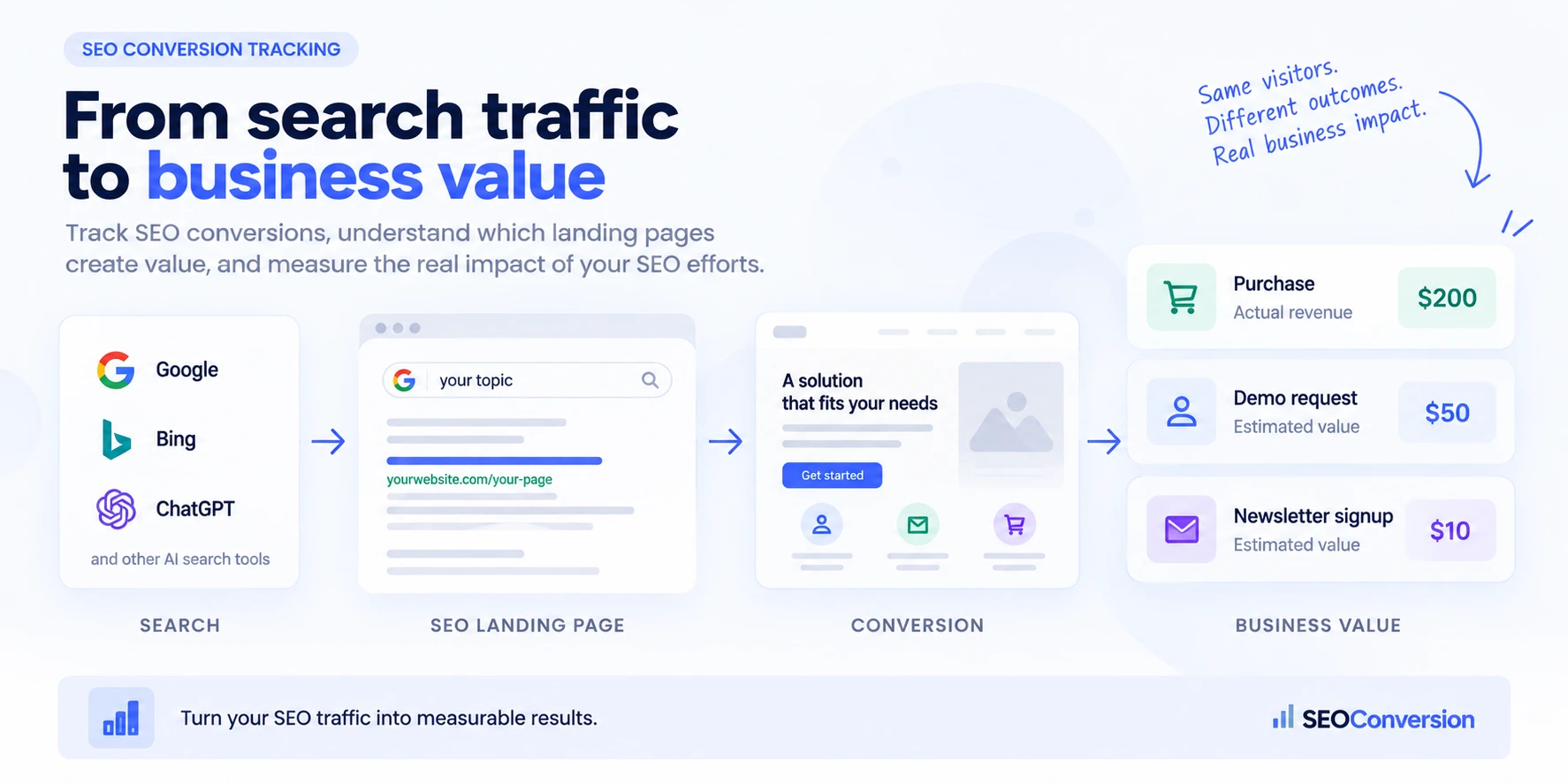
Getting more traffic from Google is useful, but traffic alone doesn’t tell you what that traffic contributes to the business. A page can attract thousands of organic visits without generating many leads or sales. Another page can receive far less traffic and still produce some of your most valuable conversions.
SEO conversion tracking connects Organic Search traffic to the actions people take after they reach your site. It lets you move beyond rankings, clicks and visits to see which organic visitors convert, which landing pages those conversions are attributed to, and what those conversions are worth.
SEO conversion tracking is the process of measuring which meaningful actions come from Organic Search. It connects organic visits to conversions such as purchases, leads, signups or demo requests, and can associate those conversions with landing pages and monetary value.
In practice, it helps answer three questions: which SEO traffic converts, which landing pages generate those conversions, and what those conversions are worth.
For purchases, you can use actual transaction revenue. For leads, signups and other actions that happen before a sale, you can assign an estimated conversion value based on how often that action becomes a paying customer.
What Is SEO Conversion Tracking?
SEO conversion tracking measures what visitors from Organic Search do after they reach your website.
The conversion itself depends on your business. An ecommerce store may care most about completed purchases. A SaaS company might track trial signups or demo requests. A service business may focus on contact forms, quote requests or qualified leads.
The important point is that a conversion represents an action that matters to the business.
Traditional SEO reporting mostly describes what happens before someone reaches the site. Rankings show where your pages appear. Impressions and clicks show how people interact with your search results. Organic traffic tells you how many visits search engines send.
Conversion tracking adds what happens next:
This makes it possible to measure SEO based on business outcomes as well as search visibility.
Why Organic Traffic Alone Isn’t Enough
Traffic is useful because it tells you whether SEO attracts visitors. The problem comes when traffic becomes the final measure of success.
Imagine an informational article that generates 15,000 organic visits a month and a commercial landing page that generates 2,000. The article clearly wins on traffic, but that doesn’t tell you which page generates more signups, leads or purchases.
The same applies to traffic growth. A 50% increase in organic visits sounds positive, but the business impact depends on what those additional visitors do. If they never take a meaningful action, the increase has a very different value from a smaller traffic increase that produces high intent conversions.
This doesn’t make traffic a vanity metric. It simply means traffic answers a different question. It tells you whether people arrive from search. Conversion tracking tells you what happens after they arrive.
What Should You Track as an SEO Conversion?
There is no universal list of SEO conversions because the right actions depend on the business model.
For an ecommerce store, a completed purchase is usually the primary conversion. Actions such as adding an item to the cart or starting checkout can also provide useful information, but they shouldn’t be treated as equivalent to a completed order.
For SaaS, conversions might include a paid subscription, trial signup, free account, demo request or another high intent product action. A service business might track quote requests, booked consultations, contact forms or qualified leads.
CTA clicks can also make sense as conversions when they represent an important step in the customer journey. The key is to avoid turning every interaction into a conversion just because it can be tracked.
A simple question helps:
If the answer is yes, the action is probably worth tracking. If the connection to the business is weak, it may be better treated as an engagement metric rather than a primary conversion.
How to Set Up SEO Conversion Tracking
A useful setup doesn’t need dozens of events. It needs a clear definition of what matters, reliable source attribution and a consistent way to interpret the results.
Step 1: Define the conversions that matter
Start with the actions closest to your business goals. These might be purchases, demo requests, leads, free signups or another important product action.
Avoid the temptation to track everything as a primary conversion. Five meaningful conversion types usually tell you more than fifty low intent events.
Step 2: Identify conversions from Organic Search
Your tracking setup needs to distinguish Organic Search from other acquisition sources. This lets you separate conversions attributed to search engines from conversions attributed to direct visits, referrals, paid campaigns or other channels.
You can then answer a basic but important question: how many tracked conversions are attributed to Organic Search?
Step 3: Connect conversions to SEO landing pages
Channel level attribution tells you how Organic Search performs overall. Landing page attribution adds another layer by showing which pages organic visitors entered through.
Instead of seeing only:
you can start to see how those conversions are distributed across your SEO landing pages.
This is particularly useful when you need to decide which existing pages deserve more attention.
Step 4: Attach revenue or value to the conversion
A purchase can use its actual transaction value.
For a conversion that doesn’t generate revenue immediately, you can estimate its value from historical business data. A lead, for example, has an expected value based on the percentage of leads that become customers and the average value of those customers.
This turns a simple conversion count into a metric that can distinguish between actions with very different business importance.
Step 5: Compare results over time and across pages
Once the tracking is in place, you can compare landing pages, conversion types and periods with the same methodology.
The purpose isn’t to find one perfect SEO metric. It’s to add conversion and value data to the search metrics you already use.
What SEO Conversion Metrics Should You Track?
You don’t need an enormous dashboard to understand whether Organic Search contributes to conversions. A relatively small set of metrics can answer most of the important questions.
- Organic conversions tell you how many tracked actions are attributed to Organic Search.
- Organic conversion rate shows the relationship between organic visits and conversions. It can help you compare pages or periods with very different traffic levels.
- Conversion value adds a monetary value to those conversions. This can represent actual transaction revenue or an estimated value, depending on the conversion.
- Value per organic visit can help compare traffic quality across pages. Two pages with similar traffic may contribute very different amounts of conversion value.
- Conversions by landing page show where your organic conversions are attributed across the site.
- Conversion value by landing page adds business context to that comparison, especially when different pages generate different types of conversions.
- Actual revenue from Organic Search, when available, provides the clearest monetary measure because it comes from completed transactions rather than an estimate.
No single metric should be interpreted in isolation. A landing page with a low direct conversion rate may sit at the beginning of the customer journey, for example, and still play a useful role.
How to Track Conversions by SEO Landing Page
Knowing that Organic Search generated 300 conversions is useful for channel reporting. It doesn’t tell you which parts of your SEO strategy contributed to those conversions.
Landing page attribution lets you break that total down. Imagine the following results:
| Landing page | Organic conversions | Conversion type | Value |
|---|---|---|---|
| /pricing | 12 | Purchase | $2,400 actual revenue |
| /demo | 35 | Demo request | $1,750 estimated value |
| /free-tool | 180 | Free signup | $900 estimated value |
The page with the highest number of conversions isn’t necessarily the page with the highest value. The type of conversion matters too.
This information can help you decide where further SEO work could have the most impact. You may find commercial pages that deserve stronger internal linking, high value pages that could benefit from better rankings, or high traffic pages whose visitors rarely progress toward a business outcome.
There is an important limitation. Attribution tells you how your measurement system assigns a conversion; it doesn’t prove that one page caused the entire customer journey. Someone may discover the brand through one page, return several times and convert later.
For a deeper look at this topic, read Organic Conversion Attribution: Tie SEO Landing Pages to Business Value.
How to Assign Value to SEO Conversions
If every conversion represented a purchase, assigning value would be straightforward. The transaction itself gives you the number.
Many SEO conversions happen earlier in the funnel. A demo request, free signup or qualified lead doesn’t come with revenue attached, but that doesn’t make it worthless.
A simple way to estimate conversion value is:
Suppose 10% of qualified leads become customers and the average customer is worth $500. The estimated value of one qualified lead is:
If Organic Search generates 100 of those leads, they represent:
This gives you a way to compare SEO pages and channels based on the expected value of the actions they generate rather than conversion counts alone.
It does not mean the business collected $5,000.
Actual revenue comes from a completed transaction.
Estimated conversion value represents the expected value of an action based on the probability that it eventually produces revenue.
If 100 organic leads have an estimated value of $50 each, you can report $5,000 in estimated conversion value. You should not report $5,000 in revenue unless those transactions actually occurred.
For the full calculation, including CTA clicks, signups, leads and multi step funnels, read How to Calculate the Value of a Lead or Conversion.
SEO Conversion Tracking in GA4 vs a Dedicated SEO Conversion Tool
GA4 can track traffic sources and conversion events, so it is entirely possible to analyze Organic Search conversions with it. For teams that already have a well configured analytics setup and know how to build the reports they need, GA4 can provide a lot of useful information.
The difference is mainly one of focus.
GA4 is a general analytics platform. It covers acquisition, engagement, ecommerce, advertising and many other areas. SEO conversion analysis is one use case among many.
A dedicated SEO conversion tool starts from a narrower question: what conversions and value came from search?
That focus can make it easier to see Organic Search conversions, compare SEO landing pages and attach business value to the actions that matter without building the reporting structure from scratch.
SEOConversion is designed around that narrower use case. It isn’t intended to replace every function of a general analytics platform. Its job is to make the relationship between search traffic, conversions and value easier to see.
What About AI Search Conversions?
Discovery doesn’t only happen through Google and Bing anymore. Visitors can also reach a website after interacting with AI assistants such as ChatGPT, Perplexity, Gemini or Copilot. Traditional Organic Search and AI referrals should stay distinct in reporting because they’re not the same acquisition channel.
For the full breakdown of how to identify that traffic, keep it separate from Organic Search, and track what it converts to, see How to Track ChatGPT, Perplexity & Gemini Conversions, Not Just Mentions.
From SEO Conversions to SEO ROI
Once you know which conversions are attributed to Organic Search and what those conversions are worth, you have one side of the SEO ROI calculation.
The basic formula is:
If a company spends $5,000 on SEO and conversions attributed to Organic Search generate $15,000 in actual revenue, the calculation is:
The calculation needs a different label when the return is based on estimated conversion value. If the $15,000 represents the expected value of leads or signups rather than completed transaction revenue, the result is an estimated SEO ROI.
SEO ROI also introduces questions that conversion tracking alone can’t answer. You need to decide which costs belong in the SEO investment, choose an appropriate measurement period and account for the fact that SEO costs and returns don’t always occur at the same time.
Those questions are covered in detail in How to Calculate and Present SEO ROI.
How to Measure SEO Performance Beyond Traffic
Conversion tracking doesn’t make traditional SEO metrics obsolete. Rankings, impressions, clicks and traffic still tell you whether your pages have visibility in search and whether that visibility brings people to your site.
The difference is that you can connect those metrics to what happens next. A useful SEO measurement framework can be viewed in five layers:
- Visibility: impressions and rankings.
- Acquisition: organic clicks and visits.
- Conversion: purchases, leads, signups, demos or other meaningful actions.
- Value: actual revenue or estimated conversion value associated with those conversions.
- Return: SEO ROI or estimated SEO ROI once SEO costs are included.
Each layer answers a different question. Together, they provide a much more complete view of SEO performance than traffic alone.
Common SEO Conversion Tracking Mistakes
One of the easiest mistakes is to classify too many actions as conversions. If every click, scroll and minor interaction becomes a primary conversion, the total may look impressive without saying much about business performance. Focus on actions with a clear connection to the outcomes the business cares about.
Another common problem is assigning arbitrary monetary values. A lead shouldn’t be worth $100 simply because $100 feels reasonable. Use historical sales data whenever you have enough of it, and update the value when conversion rates or customer values change.
Estimated conversion value also needs a clear label. A dashboard can become misleading very quickly if an estimated $10 lead value appears as $10 of revenue.
Attribution deserves the same caution. A conversion attributed to an SEO landing page tells you how the measurement system assigned credit. It doesn’t prove that the landing page was the only interaction that influenced the customer.
Finally, use the same methodology when you compare pages and periods. Changes in the measurement method can create apparent performance changes that have nothing to do with SEO itself.
How SEOConversion Tracks Search Conversions and Value
SEOConversion focuses on what happens after search traffic reaches your website. It connects tracked conversions to search sources and shows the landing pages associated with those conversions, so Organic Search doesn’t have to remain a single channel level number.
For direct purchases, conversion reporting can use transaction value when that data is available. For leads, signups and other actions that happen before a purchase, you can assign a value based on what that conversion is worth to your business. The dashboard reports both kinds of value together under the same “Revenue” total, so if your own reporting needs to separate actual revenue from estimated conversion value, that’s a distinction worth tracking on your end, based on which of your conversions use an assigned value versus an actual transaction amount.
The same approach extends to AI referrals, kept separate from Organic Search so you can compare the conversions and value associated with each form of search discovery.
The result is a reporting view built around a straightforward question: what did search traffic generate after the click?
FAQ
What is SEO conversion tracking?
SEO conversion tracking is the process of connecting Organic Search traffic to meaningful actions such as purchases, leads, signups or demo requests. It can also connect those conversions to SEO landing pages and associate them with actual revenue or estimated conversion value.
How do I track conversions from Organic Search?
First define the actions that count as conversions for your business. Your tracking setup then needs to identify visits attributed to Organic Search and connect those visits to the conversions that occur afterwards. Landing page attribution can add another layer by showing which SEO pages are associated with those conversions.
What is an SEO conversion?
An SEO conversion is a meaningful action attributed to Organic Search traffic. Depending on the business, it can be a purchase, lead, signup, trial, demo request, quote request or another action that represents progress toward a business goal.
What SEO conversion metrics should I track?
Useful metrics include organic conversions, organic conversion rate, actual revenue or estimated conversion value, value per organic visit, conversions by landing page and conversion value by landing page. The most useful combination depends on your business model and the types of conversions you track.
What is a good organic conversion rate?
There is no universal organic conversion rate that works as a benchmark for every website. Conversion rates vary based on the business model, conversion type, search intent, traffic quality and the role of the landing page in the customer journey. Your own historical performance and comparisons between similar pages usually provide more useful context.
How do you calculate the value of an SEO conversion?
For a purchase, use the actual transaction value. For a lead or another action that happens before a purchase, you can estimate its value by multiplying the conversion to customer rate by average customer value. If 10% of leads become customers worth $500, one lead has an estimated conversion value of $50.
Is conversion value the same as revenue?
No. Revenue comes from an actual transaction. Estimated conversion value represents what an action is expected to be worth based on historical conversion rates and customer value. The two should be labeled separately in reports.
Can GA4 track SEO conversions?
Yes. GA4 can track conversion events and acquisition sources, including Organic Search. A dedicated SEO conversion tool serves a narrower purpose and can make search conversion, landing page and value reporting more directly accessible.
Does Google Search Console track conversions?
Google Search Console reports search performance data such as impressions, clicks, queries and pages. It doesn't provide the complete post click conversion and business value reporting described in this guide.
Can I track conversions from ChatGPT and AI search?
Yes. AI referral traffic can be measured for downstream conversions when your tracking setup identifies the referral source and connects it to tracked actions, kept separate from traditional Organic Search. See How to Track ChatGPT, Perplexity & Gemini Conversions, Not Just Mentions for the full setup.
Connect SEO Traffic to Business Outcomes
SEO conversion tracking adds the part of search reporting that rankings and traffic can’t provide on their own: what visitors do after they arrive and what those actions contribute to the business.
The process starts with a small number of meaningful conversions. From there, you can connect those actions to Organic Search, analyze them by landing page, attach actual revenue or estimated value, and eventually compare that return with your SEO investment.
For a deeper look at each part of the process:
Connect SEO traffic to business outcomes.
SEOConversion brings conversion and value signals into a search-focused view, so you can see what Organic Search and AI referrals generate beyond the click.
Start free