
Organic Conversion Attribution: Tie SEO Landing Pages to Business Value
Google Search Console tells you which pages get impressions and clicks. Your analytics tool tells you how much traffic each page gets. Neither one answers the question that actually matters to the business:
That’s what organic conversion attribution is for.
What Is Organic Conversion Attribution?
Organic conversion attribution means connecting a conversion back to the search visit that generated it.
Knowing that Organic Search generated 300 conversions is a start, but it’s not enough on its own. What you really want to know looks more like this:
/email-findergenerated 120 conversions/pricinggenerated 40 conversions/blog/examplegenerated 10 conversions
That level of detail is what lets you tell which SEO pages actually contribute to the business, instead of which ones simply rank.
Why Organic Traffic Alone Doesn’t Tell You Enough
Here’s a simple example.
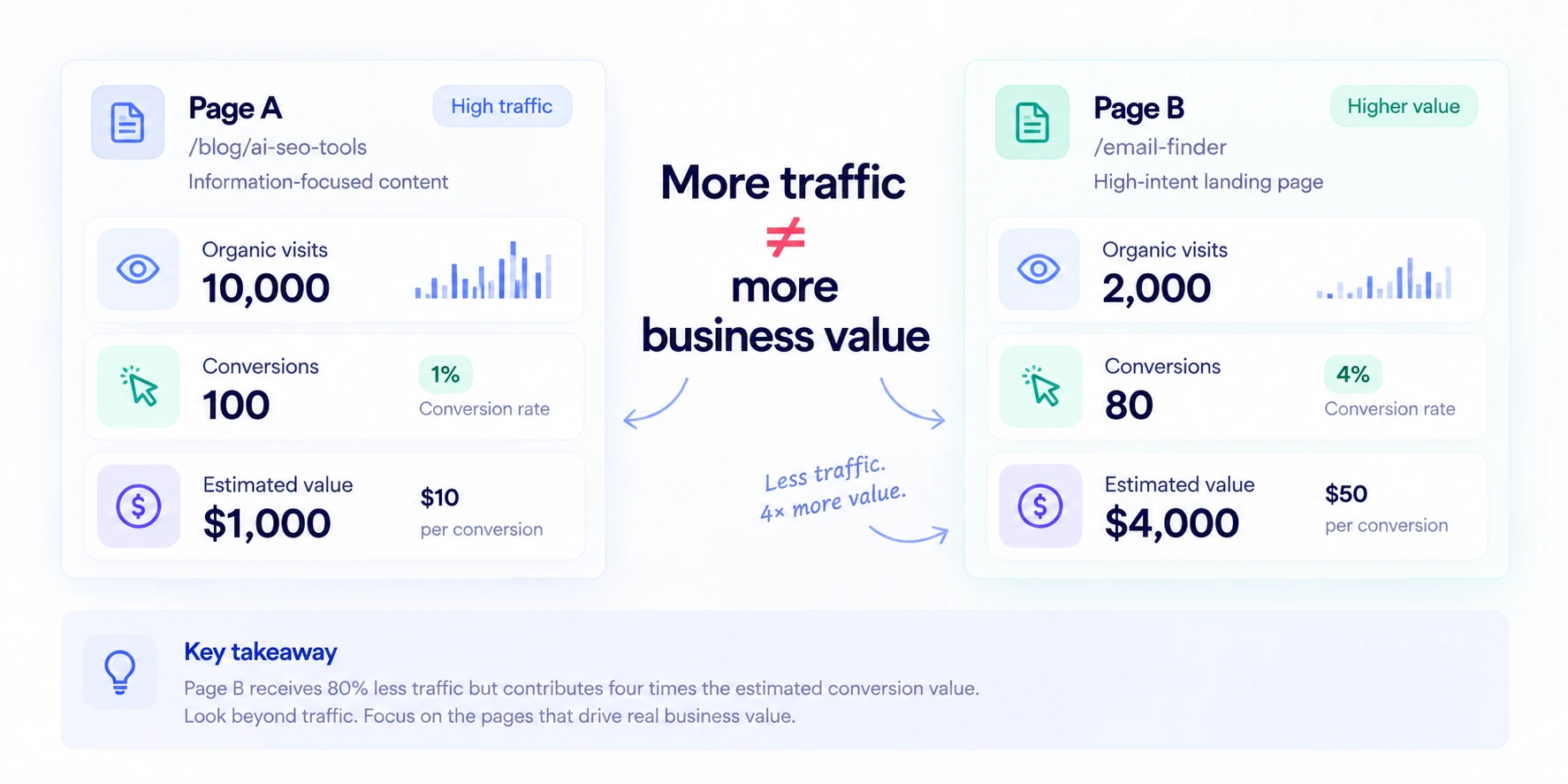
Page A — 10,000 organic visits, 100 conversions, 1% conversion rate.
Page B — 2,000 organic visits, 80 conversions, 4% conversion rate.
Based on traffic alone, Page A looks like the clear winner. It gets five times more visits. But look at conversions, and Page B suddenly looks a lot more interesting: fewer visits, almost as many conversions.
Now add value. Say each conversion on Page A is worth $10:
And each conversion on Page B is worth $50:
Page B gets 80% less traffic and contributes four times the estimated conversion value. Traffic alone would have completely hidden that.
How SEO Landing Page Attribution Works
The path looks like this:
Someone searches for something on Google and lands directly on /email-finder. They browse the site, click a CTA, or fill out a form. That conversion gets tied back to the landing page that started the visit — the page they arrived on, not necessarily the page the conversion happened on if they clicked around first.
That attribution holds for the length of that visit. SEOConversion doesn’t use cookies or a persistent visitor ID — if someone leaves and comes back after a gap, or on a different day, the return is treated as a new visit with its own landing page, not a continuation of the first one. In practice, this means landing-page attribution is precise for the visit it happens in, rather than a multi-day lookback across everything a visitor did before converting.
Conversion Attribution vs Conversion Value
These two concepts answer different questions.
Attribution answers: where did this conversion come from?
Conversion value answers: how much is this conversion worth?
Put together: where did the conversion come from, and what was it worth?
If you haven’t calculated conversion value yet, start with How to Calculate the Value of a Lead or Conversion.
How to Compare SEO Landing Pages by Business Value
Once you have organic visits (from Search Console or your analytics), conversions, and estimated value side by side, patterns show up fast.
| Landing page | Organic visits | Conversions | Conversion rate | Est. conversion value |
|---|---|---|---|---|
| Page A | 10,000 | 100 | 1% | $1,000 |
| Page B | 2,000 | 80 | 4% | $4,000 |
| Page C | 5,000 | 25 | 0.5% | $500 |
Page A brings in a lot of traffic. Page B brings in far less traffic but a lot more estimated value. Page C brings in a decent amount of traffic but relatively little direct conversion value. That could be worth investigating, although it doesn’t necessarily mean the page is underperforming.
Be careful not to jump straight to “good page” or “bad page” labels here. Some pages naturally sit higher in the funnel, and a lower conversion rate doesn’t automatically mean something is broken.
What Organic Conversion Attribution Can Tell You
With this data in hand, you can:
- Identify which SEO landing pages generate the most conversions
- Identify which ones generate the most value
- Spot pages with a lot of traffic but very few conversions
- Find pages with relatively little traffic but a high value per visit
- Prioritize which pages to optimize next
- Show SEO’s contribution to business outcomes, not just rankings and traffic
What Organic Conversion Attribution Cannot Tell You
Attribution isn’t proof that a landing page is the only reason someone became a customer.
Most people interact with a brand more than once before buying. An informational page might play a real role in that journey without ever receiving the conversion directly.
Attribution is a model for understanding SEO’s contribution. It’s not a complete picture of every influence that led to a sale.
Organic Conversion Attribution vs Google Search Console
This isn’t about replacing Search Console. The two tools answer different questions.
Search Console tells you:
- What queries generate impressions and clicks
- Which pages receive organic clicks
- How search visibility changes over time
Conversion attribution tells you:
- Which organic landing pages generate conversions
- What their conversion rate is
- What business value those conversions represent
Search Console tells you how people find you. Conversion attribution tells you what happens after they arrive.
How SEOConversion Tracks Organic Conversions by Landing Page
SEOConversion attributes each conversion to the landing page of the visit it happened in, then attaches the value you’ve assigned to that conversion. On the SEO Conversions page, you get organic conversions and revenue broken down by landing page — sortable by conversions or by revenue — so you can see at a glance which pages are contributing the most, not just which ones get the most clicks.
From Organic Conversion Attribution to SEO ROI
Once you know which conversions come from SEO, which landing pages generate them, and what those conversions are worth, you have what you need to start calculating the return on your SEO work. That’s exactly what How to Calculate and Present SEO ROI covers next.
FAQ
What is organic conversion attribution?
It's the practice of connecting a conversion back to the organic search visit, and specifically the landing page, that generated it.
How do I track conversions from organic search?
You need a tool that can identify traffic coming from organic search and attribute tracked conversions back to that source and landing page.
Can Google Search Console track conversions?
No. Search Console reports on queries, impressions, clicks, and rankings. It doesn't tell you what visitors did after they landed on your site.
How do I know which SEO landing page generated a conversion?
You need attribution at the landing page level, tying the conversion back to the specific page that started the session, rather than crediting Organic Search as a whole.
What is the difference between organic conversions and organic traffic?
Organic traffic counts visits. Organic conversions count the visits that led to a meaningful action, like a signup, a lead, or a purchase. A page can have high traffic and low conversions, or the reverse.
How do you assign value to an organic conversion?
Short version: multiply your conversion-to-customer rate by your average customer value. For the full formula and examples, see How to Calculate the Value of a Lead or Conversion.
Traffic tells you what got visited. Value tells you what matters.
SEOConversion connects organic conversions and their value to the landing pages they're attributed to, so you can see which pages actually earn their traffic.
Start free