
How to Calculate the Value of a Lead or Conversion
If you sell a product directly, this part is easy. Someone paid, and you know the number.
Most conversions don’t work that way. A demo request, a free signup, a form fill, a click on your main button. None of these come with a price tag attached. But they’re not worthless either. You just need a way to put a real number on them.
That’s what this article covers: a simple formula to calculate conversion value using numbers you probably already have.
What Is Conversion Value?
A conversion is any action you’ve decided matters enough to track. A purchase, a lead, a demo request, a signup, a click on a high-intent button, a form submission.
Conversion value is the dollar amount you put on that action.
For a purchase, that part is simple. The value is the transaction amount. For everything else, the action itself has no price tag. A demo request isn’t worth zero. Clearly something good happened. But it’s also not worth the full price of your product, because not everyone who books a demo buys. The real value sits somewhere between those two numbers, and that’s what we’re about to work out.
The Simple Conversion Value Formula
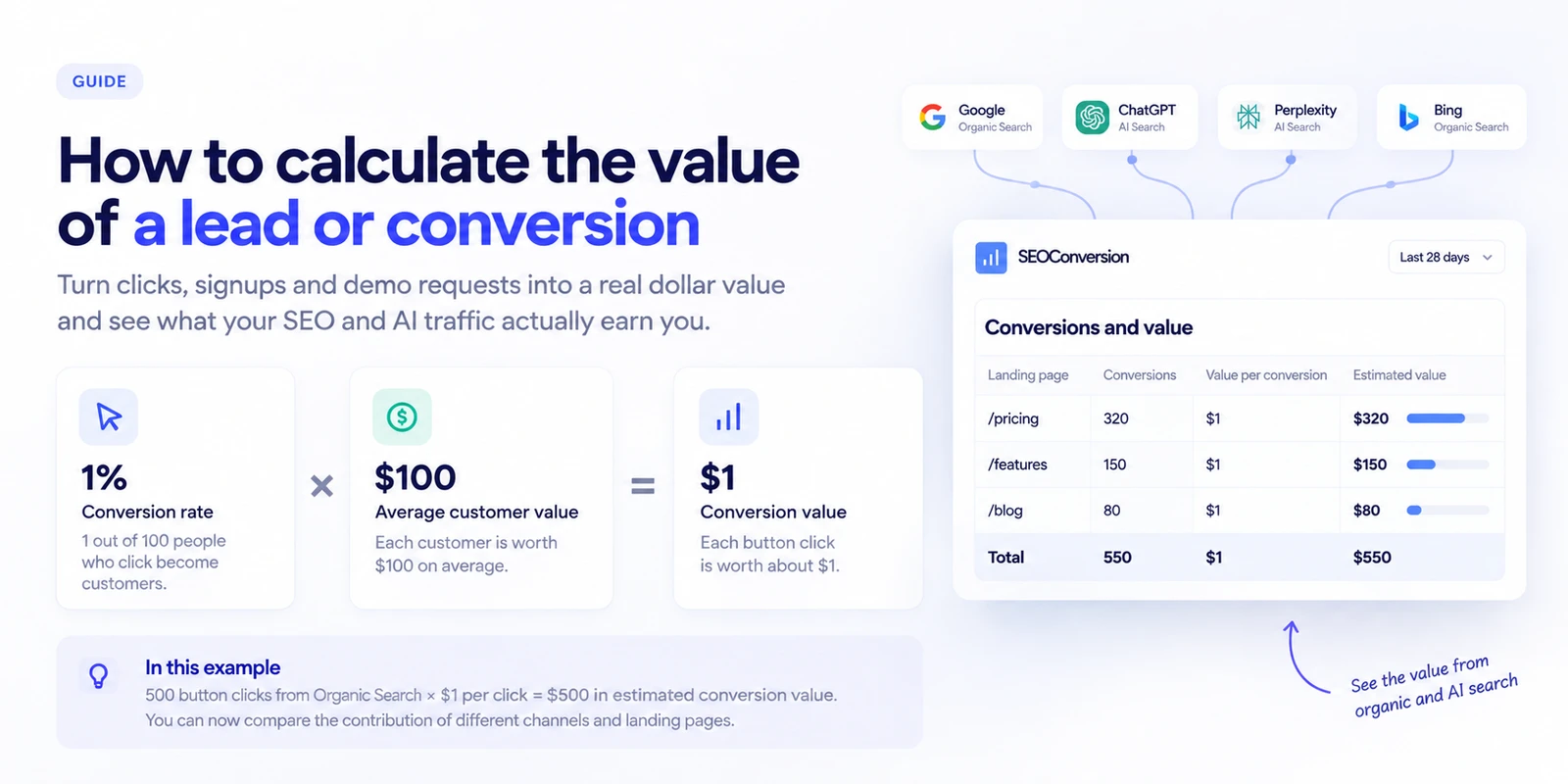
Here’s the formula behind almost every estimate in this article:
For direct purchases, you don’t need this formula. Use the actual transaction value instead. This formula is for everything that isn’t a sale yet: leads, signups, demo requests, clicks.
In plain terms: if you know what share of people who take an action end up becoming paying customers, and you know what a customer is worth on average, multiply the two together. That’s your estimated value.
Take a site that treats a click on its main button as a conversion. Out of 100 people who click it, 1 becomes a customer. The subscription they buy is worth $100.
So a click on that button carries an estimated value of about $1. It’s a small number, but it holds up at scale. If 500 of those clicks get credited to Organic Search in a given month:
That gives you an estimated conversion value of $500 for those 500 clicks. You can now use that number to compare the contribution of different channels and landing pages. We’ll get into exactly what this number does and doesn’t represent a little further down.
How to Calculate Lead Value
The same lead value formula works here too. Say you have:
- 100 leads
- 10 of them become customers
- Average customer value: $500
Once you have this number, you can compare landing pages and channels on more meaningful terms. Not just by how many leads each one produced, but by their estimated business value.
How to Value Different Types of Conversions
Not every conversion should be valued the same way. Here’s how the formula changes depending on what you’re tracking:
- Purchase: use the real transaction revenue. No estimation needed here.
- Qualified lead: probability of becoming a customer times average customer value.
- Demo request: demo-to-customer rate times average customer value.
- Free signup: free-to-paid rate times average customer value.
- CTA click: click-to-paid rate times average customer value.
- Contact form submission: form-to-customer rate times average customer value.
The logic stays the same in every case. Only the conversion rate changes.
What If There Are Several Steps Before a Purchase?
Most funnels have more than one step. A visitor clicks a button, signs up, gets qualified as a lead, and only then becomes a customer. You don’t need to guess a value for each step along the way. You just need the overall odds of reaching a customer from the step you care about.
Say you have:
- 100 CTA clicks
- 20 signups
- 5 qualified leads
- 2 customers
- Average customer value: $200
The overall rate from click to customer is:
So the estimated value of a single CTA click is:
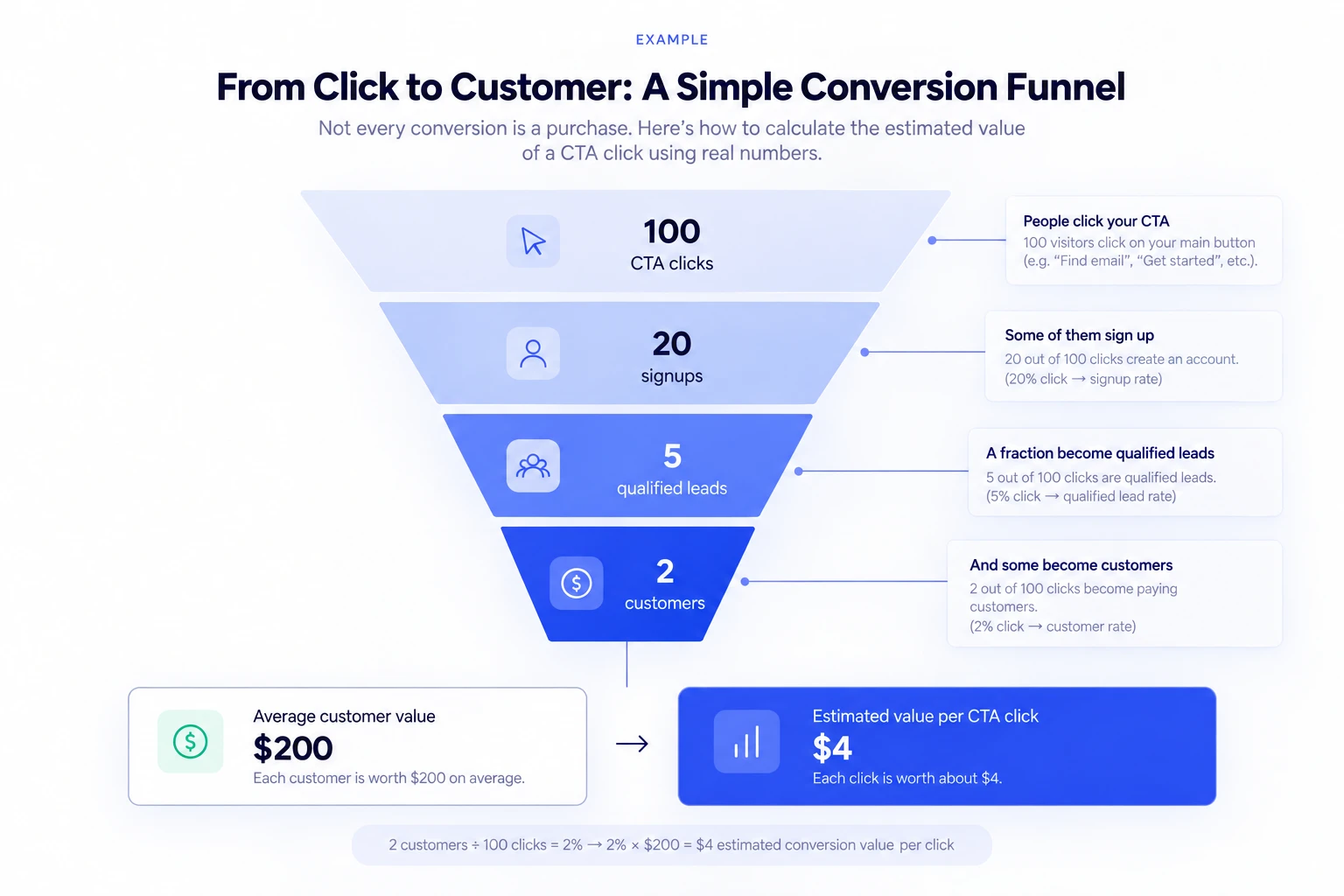
There’s no need to assign an arbitrary value to each step in between (the signup, the qualified lead) unless you specifically want to track those separately. The end-to-end rate does the job on its own.
Why does this matter for SEO?
Say Page A generates 200 CTA clicks and Page B generates 50. If each click carries an estimated value of $4, Page A contributed an estimated $800 in conversion value, and Page B contributed $200. Instead of reporting SEO performance in clicks or conversions alone, you can start comparing landing pages by their estimated business value.
Should You Use Revenue, AOV or Customer Lifetime Value?
It depends on what you’re trying to measure. The important part is documenting which value you’re using, and applying the same method every time you compare channels, pages, or periods.
For e-commerce, use the real order value of the transaction. It’s immediate and it’s simple. For SaaS, you can use the first payment, the annual contract value, or customer lifetime value (LTV). LTV itself is an estimate, and it can be calculated more than one way, so treat it with the same care you’re giving conversion value in the first place.
Whatever you pick, don’t mix methods across comparisons. If one channel is valued on first payment and another on LTV, one will look stronger than the other even if their real performance is identical.
Estimated Conversion Value vs Actual Revenue
This is the most important distinction in this whole article, so let’s be precise about it.
Actual revenue is money you’ve actually collected from a transaction.
Estimated conversion value is the expected dollar amount you assign to an action, based on how often actions like it turn into revenue.
A conversion valued at $10 doesn’t mean you collected $10. It means that, based on your numbers, actions like this one tend to be worth about $10 once you factor in how often they lead to a paying customer.
Both numbers matter. But they answer different questions: how much did we make, versus how much is this action likely worth. Confuse the two, and a marketing report quietly turns misleading. Keep them labeled separately everywhere: in your dashboard, your case studies, and anything you publish.
How to Set Conversion Values in SEOConversion
Once you’ve worked out a value using the formula above, you can apply it to your tracked conversions directly.
Say you’ve figured out that 1% of people who click “Find email” become customers worth $100. That gives you an estimated conversion value of $1 for that action. You can set that value on the “Find email” conversion in your dashboard. SEOConversion will then use it to show you the value coming from Organic Search and from AI assistant referrals, like Claude, ChatGPT, Perplexity, Gemini, and Copilot, broken down by landing page.
How Often Should You Update Conversion Values?
Update a conversion’s value any time one of its inputs changes in a real way:
- Your pricing changes.
- Your conversion rate shifts, whether that’s lead-to-customer or demo-to-customer.
- Your average customer value moves.
Treat conversion value as a working number, not a fixed truth. A value set a year ago on last year’s pricing and conversion rates will quietly steer you wrong if nobody revisits it.
FAQ
What is a good conversion value?
There's no universal number here. It depends on your average customer value and your conversion rate at each step. A $1 conversion value can be great for a high-volume, low-price product, and a poor result for a high-ticket B2B sale.
How do you calculate the value of a lead?
Multiply your lead-to-customer rate by your average customer value. If 10% of leads become customers worth $500 on average, each lead is worth $50.
What if I don't know my lead-to-customer conversion rate?
Start with historical sales or CRM data if you have it. Look at how many leads you generated over the last 3 to 6 months and how many of them became customers. If you don't have enough data yet, use a conservative estimate and clearly treat the resulting conversion value as provisional. Update it once real data comes in.
Should I use revenue or customer lifetime value?
It depends on what you're trying to measure. You can use first payment, annual contract value, or LTV, but document your method and apply it consistently. Remember that LTV is itself an estimate, so don't present an LTV based conversion value as actual revenue.
Is conversion value the same as revenue?
No. Revenue is money you’ve actually collected. Conversion value is an estimate of what an action is likely worth. Keep the two clearly labeled, and never present one as the other.
Can I assign a value to a button click?
Yes, as long as you can connect that click to a downstream conversion rate, even loosely. The formula doesn't require the click to be a sale. It just needs to know how often clicks like this one turn into one.
Know what a conversion is worth. Now find out where it came from.
SEOConversion connects every conversion, and the value you put on it, to the channel that earned it: Organic Search or an AI assistant like ChatGPT or Perplexity.
Start free