
SEO Revenue: How to Measure, Attribute and Grow It


SEO revenue is the money your business earns from visitors who arrive through unpaid search results: purchases, subscriptions, or the value of leads that become customers. You measure it by giving every conversion a value and reporting it by organic landing page, and you grow it by moving one of four levers: impressions, click-through rate, conversion rate or value per conversion.
Traffic and rankings are inputs. Revenue is the result your boss, client or bank account cares about. This guide shows how to calculate it, why the number in your analytics is often wrong, how to tell which lever moved when it changes, and what actually grows it.
What Counts as SEO Revenue
SEO revenue covers any value created by a visit that started on an unpaid search result. What that value looks like depends on how you make money:
- Ecommerce: purchase revenue from orders placed in organic sessions.
- Lead generation: the expected value of form fills, calls and demo requests, based on how many become customers.
- SaaS: trials and signups that turn into paid plans, ideally tracked through to recurring revenue.
- Publishers: subscriptions started by search readers, plus ad revenue earned on their pageviews.
In accounting, “organic revenue” means something else: growth from existing operations, excluding acquisitions. If that is the meaning you need, see our guide to organic revenue. Here, “organic” means unpaid search.
Where AI search revenue fits
Search now includes AI answers, and GA4 splits them in a way many reports miss. Per Google’s default channel group definitions, the Organic Search channel includes clicks from Google’s AI Overviews and AI Mode. Visits from ChatGPT, Gemini, Copilot and similar assistants go to a separate AI Assistant channel. When an assistant sends no referrer at all, the visit is counted as Direct.
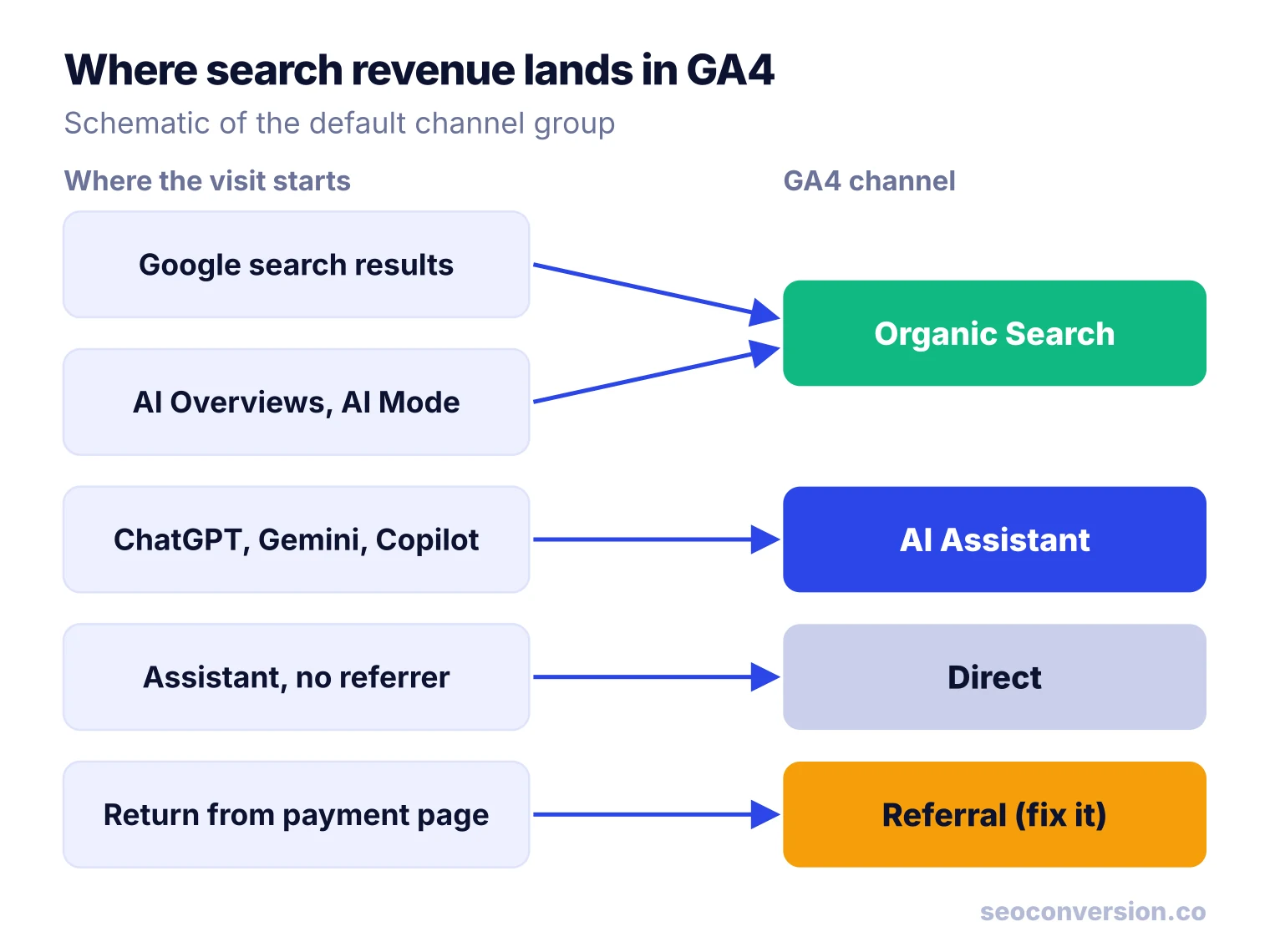
So decide up front what your “SEO revenue” includes. A practical definition: Organic Search revenue as your SEO number, with AI Assistant revenue reported next to it, because the same content earns both. Our guide to AI conversion tracking covers the assistant side.
The SEO Revenue Formula
Every dollar of SEO revenue passes through the same four steps, so the formula is a chain of four numbers:
- Impressions (Search Console): how often your pages appear in results.
- CTR (Search Console): the share of impressions that become clicks. Impressions × CTR gives organic clicks, which roughly match organic sessions in analytics.
- Conversion rate (analytics): the share of organic sessions that buy, sign up or submit a lead.
- Value per conversion: average order value for a store, or value per lead for a service business.
The first two numbers are the visibility side of SEO. The last two are the conversion side, and they are just as much part of SEO revenue: doubling the conversion rate of a landing page doubles its revenue without a single new ranking.
Worked Example: Why SEO Revenue Changed This Month
A store sees SEO revenue rise from $24,000 in August to $27,000 in September. Good news, but which part of SEO did it? Splitting the change by lever answers that. All numbers below are illustrative, and clicks stand in for sessions to keep the arithmetic simple.
| Lever | August | September |
|---|---|---|
| Impressions | 1,000,000 | 1,250,000 |
| CTR | 2.0% | 1.6% |
| Organic clicks | 20,000 | 20,000 |
| Conversion rate | 1.5% | 1.8% |
| Orders | 300 | 360 |
| Average order value | $80 | $75 |
| SEO revenue | $24,000 | $27,000 |
Now change one lever at a time, in funnel order, and record what each change adds:
- Impressions. 1,250,000 × 2.0% × 1.5% × $80 = $30,000. That is +$6,000.
- CTR. 1,250,000 × 1.6% × 1.5% × $80 = $24,000. That is −$6,000.
- Conversion rate. 20,000 × 1.8% × $80 = $28,800. That is +$4,800.
- Order value. 360 × $75 = $27,000. That is −$1,800.
The four effects add up to the real change: +$6,000 − $6,000 + $4,800 − $1,800 = +$3,000.
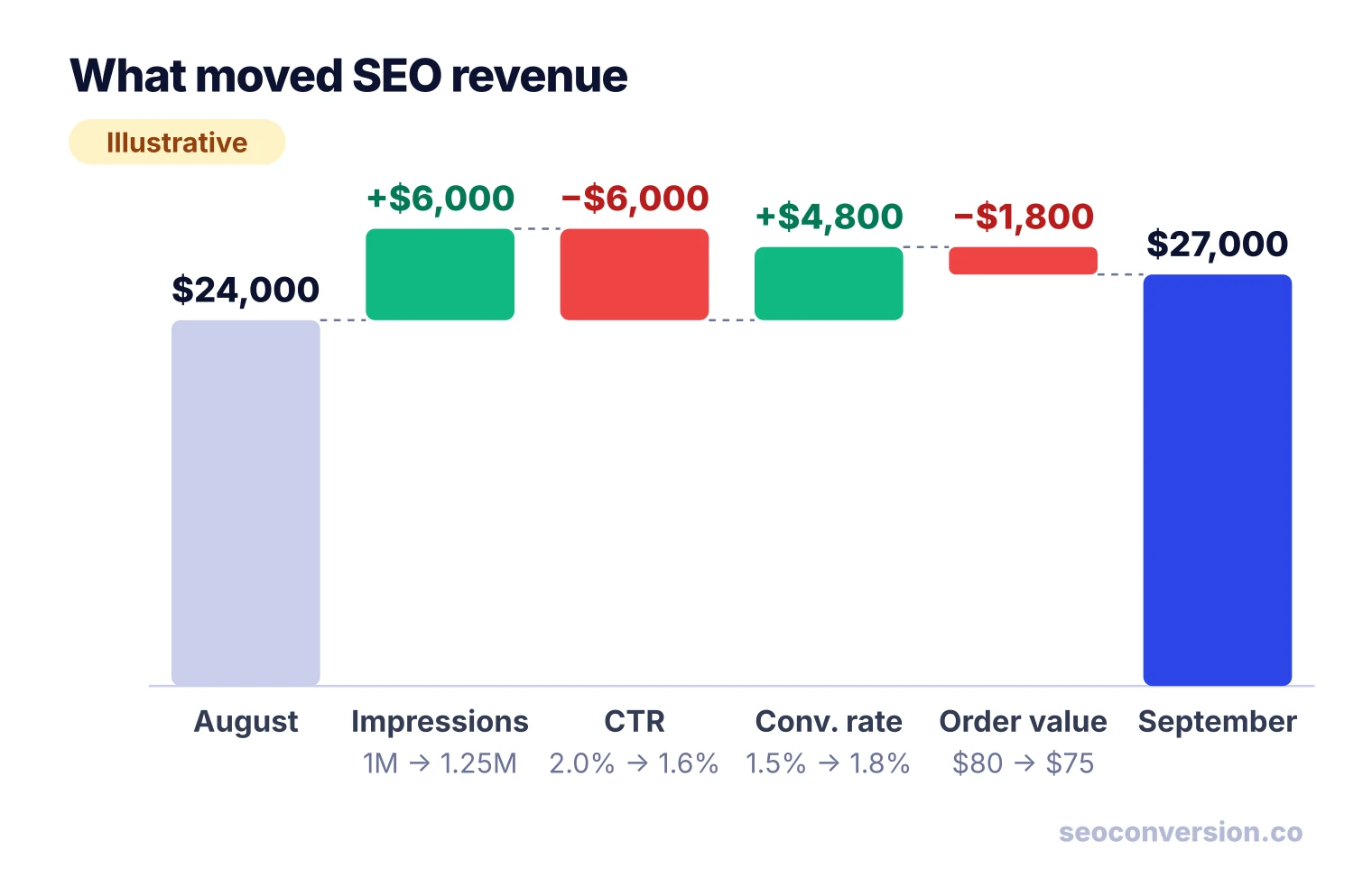
The story is not “SEO is growing.” Visibility grew, but clicks did not, because CTR fell by the same amount. A falling CTR with rising impressions often means you are showing for broader queries, or answer boxes and AI Overviews are taking the click. All the real gain came from conversion rate, which is a landing page result, while a lower order value gave some back. Next month’s work is obvious: check titles and snippets on the pages that lost CTR, and find out what lifted conversion so you can repeat it.
The split depends on the order you change the levers in. Funnel order (impressions first, value last) is a sensible convention; keep the same order every month so the reports stay comparable.
How to Measure SEO Revenue in GA4
Ecommerce
- Make sure purchase events send a value and currency. Without them, revenue reads zero for every channel.
- Open Reports > Acquisition > Traffic acquisition and read revenue on the Organic Search row.
- Switch to the Landing page report, filtered to Organic Search, to see which pages start the sessions that buy.
- Add the AI Assistant row next to it if you report AI search revenue too.
Lead generation
A lead form has no checkout, so you supply the value. Work it out from your own sales data (illustrative numbers):
Send $1,000 as the value of each lead event and GA4 adds it up by channel and landing page for you. When deals close, compare expected value with closed revenue from your CRM and adjust the per-lead value each quarter. Our guide on how to calculate conversion value covers the method in detail, and SEO conversion tracking covers which actions to track in the first place.
Report by landing page, not by keyword. Search engines do not pass the search query to your site, so no analytics tool can tell you the revenue of a keyword. The landing page is the most precise level that is still true. SEOConversion is built around that: it reports conversions and their value from Google, Bing and AI assistants by landing page, from one script tag.
SEO Revenue by Business Model
| Business | What counts as SEO revenue | Value to send | Where to confirm it |
|---|---|---|---|
| Online store | Orders from organic sessions | Order total (net of discounts) | Store orders and refunds |
| Service / lead gen | Leads × close rate × deal value | Value per lead | CRM closed deals |
| SaaS | Trials or signups that convert to paid | Expected value per trial, then real plan value | Billing system |
| Publisher | Subscriptions started by search readers, plus ad revenue | First-period or expected subscription value | Subscription platform |
| Local business | Calls, bookings and direction requests that turn into jobs | Average job value × booking rate | Booking or call logs |
Attributed vs Earned: How Much SEO Revenue Did SEO Create?
The Organic Search row tells you which revenue arrived through search. It does not tell you how much of it SEO created. Two effects pull in opposite directions.
Branded search inflates it
Someone who types your brand name was going to find you anyway. Revenue from those visits shows up as SEO revenue, but your SEO work earned little of it. Split the number: revenue landing on the homepage and brand pages on one side, revenue landing on product, category, service and article pages on the other. For example (illustrative), if $9,000 of the $27,000 above started on the homepage, the revenue your non-branded pages earned is closer to $18,000. Our guide to branded vs non-branded traffic shows how to make the split in Search Console.
Last-click reports deflate it
A buyer reads your guide from Google, leaves, and comes back a week later through an email or a branded search to buy. Last-click reporting credits the email or the brand visit. Content that starts journeys looks like it earns nothing. Compare a first-click or data-driven view before you cut it; our revenue attribution guide explains the models.
Neither effect cancels the other neatly, so report both: attributed SEO revenue, and the share from non-branded landing pages. The second number is the one that moves when your SEO work moves.
Why Your SEO Revenue Number Is Wrong: Failure Modes and Fixes
| Symptom | Likely cause | Fix |
|---|---|---|
| A payment provider is one of your top revenue sources | Buyers return from an external checkout and start a new referral session | Add the payment domain to the unwanted referrals list |
| Organic revenue reads $0 on a lead-gen site | Lead events carry no value | Send a value per lead with each conversion event |
| SEO revenue is higher than what finance reports | Refunds, cancellations and test orders are still counted | Send refund events, or reconcile against net revenue monthly |
| Revenue drops when visitors move between your domains | Cross-domain tracking is missing, so the second domain starts a new session | Configure cross-domain measurement for every domain in the checkout path |
| Direct revenue grows while AI assistants send traffic | Some assistants and apps pass no referrer | Tag links you control with UTM parameters; accept that the rest stays Direct |
| Revenue falls but orders in the store do not | Visitors who decline cookies or block scripts are not measured | Compare analytics revenue with store revenue to size the gap, and keep it in your reports |
The first row is common enough that Google documents it: in GA4 you go to Admin > Data streams > your web stream > Configure tag settings > List unwanted referrals, and add up to 50 domains per stream. Fix these before you judge any SEO revenue trend.
SEO Revenue KPIs to Track
Visibility and engagement metrics explain revenue; they do not replace it. Track them as the levers in the formula, and judge SEO on the last rows.
| KPI | What it tells you | Source |
|---|---|---|
| Impressions (non-branded) | Whether more searchers see you | Search Console |
| CTR by page | Whether your titles and snippets earn the click | Search Console |
| Rankings | Where you stand for target queries; useful for diagnosis only | Search Console or a rank tracker |
| Organic sessions by landing page | Which pages bring visitors | Analytics |
| Conversion rate by landing page | Which pages turn visitors into buyers or leads | Analytics |
| Revenue per organic session | What an average organic visit is worth, comparable across months | Analytics |
| SEO revenue by landing page | Which pages earn money, and which only earn traffic | Analytics or a conversion tracker |
| Non-branded share of SEO revenue | How much revenue your SEO work created | Analytics, grouped by landing page |
| SEO ROI | Whether revenue covers what you spend | Revenue minus cost, divided by cost |
Bounce rate, time on site and pageviews can help diagnose a single page, but none of them is a revenue measure. For the ROI row, see how to calculate SEO ROI.
How to Grow SEO Revenue
Each lever in the formula has its own fixes. Start with the one your bridge says is weakest.
More impressions on queries that buy
- Target high-intent keywords first: product, category, comparison, pricing and “near me” queries. A page that ranks for a query nobody buys from adds impressions and no revenue.
- Match the page type Google already ranks: if the top results are category pages, a blog post will struggle, and the reverse.
- Fix crawl and indexing problems that keep money pages out of the index: wrong noindex or canonical tags, orphan pages, broken links.
- Use articles to support money pages with internal links, so informational traffic flows toward pages that convert.
Higher CTR
- Rewrite titles and meta descriptions on pages with many impressions and low CTR. Show the price, the offer or the specific answer.
- Add structured data that fits the page (products, reviews, FAQs where eligible) to earn richer results.
Higher conversion rate on organic landing pages
- Treat every top organic landing page as a conversion page: one clear next step that fits what the searcher came for.
- Put the call to action where readers decide, not only at the bottom. On articles, link to the product or service page that solves the problem.
- Remove friction: slow pages, long forms, surprise costs at checkout. See landing page optimization for SEO.
Higher value per conversion
- Rank pages for higher-value products and services, not only the cheapest ones.
- Add bundles, related products or plan comparisons to the pages organic visitors land on.
Protect what you already earn
Revenue from a page is not permanent. Competitors improve, results pages change and content goes stale, so pages that earned money last year slowly earn less. Review your top revenue pages each quarter, refresh the ones losing clicks, and test template changes before rolling them out site-wide: an SEO experiment tells you whether a change helped or quietly cost you revenue.
How Long Before SEO Produces Revenue
Longer than ads, and the top results give different timelines because sites start from different places. A store whose category pages already rank can see revenue move within weeks of fixing titles or conversion rate. A new site in a competitive niche usually waits many months for rankings on commercial queries. What is consistent: impressions move first, then clicks, then conversions and revenue, so watch them in that order and judge revenue only once clicks have arrived on pages that can convert. Our guide is SEO worth it includes a break-even calculation and a first-year checkpoint plan.
Does AI Search Shrink SEO Revenue?
AI Overviews and assistants answer some questions without a click, so informational pages can lose visits. That hurts revenue less than traffic charts suggest, for two reasons. First, queries close to a purchase still lead to clicks: people want to see the product, the price or the provider. Second, the clicks that do come from AI answers are counted: in Organic Search for Google’s AI features, and in AI Assistant or Direct for the rest.
The practical shift is in measurement. If you report traffic, AI search looks like decline. If you report revenue per landing page, you see whether the pages that matter still earn. SEO is not being replaced by AI: AI answers are built from web pages, so pages that get found and convert still matter.
SEO Revenue as a Career or Business
Some people searching “SEO revenue” want to know what SEO earns the person doing it. Income comes from five models: an in-house salary, freelance hourly or project fees, monthly retainers, an agency, or owned and affiliate sites that earn from their own traffic. Pay varies widely by country, niche and seniority, so check current salary data for your market rather than trusting a single average.
Across all five, the same thing raises income: proof of revenue. A consultant who can say, for example, “these 12 pages produced $80,000 of qualified leads last quarter” (illustrative) negotiates very differently from one who reports keyword positions. If you sell SEO services, see SEO retainer pricing for how to structure that offer.
FAQ
Is SEO still worth it in 2026?
For most sites that sell something people search for, yes, but the only reliable answer comes from your own numbers. Put a value on every conversion, report revenue by organic landing page, and compare it with what you spend. If revenue per landing page grows quarter over quarter, SEO is paying; if it stays flat after a year of work, change the pages you target.
Is SEO being phased out or replaced by AI?
No. AI Overviews, AI Mode and assistants like ChatGPT change how people click, but they still pull answers from indexed web pages, and Google counts AI Overview and AI Mode clicks as Organic Search in GA4. What is fading is traffic as the main success metric. Revenue and conversions per landing page are a better test of SEO than visits.
Is SEO a high income skill?
It can be, and the deciding factor is whether you can tie your work to revenue. Specialists who report rankings compete on price; specialists who show which pages produce sales and leads can price on results. The same skill also pays through owned sites, affiliate sites and agencies, where income depends on traffic that converts.
Is an SEO job difficult?
The basics are learnable in months, but results are slow and you control only part of them: algorithm updates, competitors and AI answers all move your numbers. The hard part for most people is explaining value to a boss or client. Learning to measure conversions and revenue by landing page makes that conversation much easier.
How do I calculate revenue from SEO?
For ecommerce, read purchase revenue for the Organic Search channel and break it down by landing page. For lead generation, multiply organic leads by your lead-to-customer rate and average deal value, or send that value with each lead event so analytics adds it up for you. Then check what share of that revenue starts on branded pages.
What is a good SEO revenue growth rate?
There is no universal benchmark worth trusting, because it depends on your niche, starting point and spend. Compare against your own history instead: year over year for seasonal businesses, and month over month split into impressions, CTR, conversion rate and order value so you know which lever moved.
See which landing pages earn your SEO revenue.
SEOConversion tracks conversions from Google, Bing and AI assistants, lets you put a value on each one, and reports the revenue by landing page.
Start free