
What Is AEO & GEO? A Practical Guide
Two acronyms have shown up in most SEO conversations over the past couple of years: AEO and GEO. Both reflect a broader shift in search: getting found is no longer only about ranking a blue link in Google. People increasingly ask questions to ChatGPT, Perplexity, Gemini, and Copilot instead of typing a query into a search bar, and that changes what “being found” means.
This guide covers what each term actually means, how they differ from traditional SEO, and the part most explainers skip: knowing the definitions doesn’t tell you whether your AEO or GEO work is bringing in anything real.
For a more general look at how AI search changes the user journey and what to measure, AI Search vs Traditional SEO: What Actually Changes for Measurement is a good companion read.
What Is AEO (Answer Engine Optimization)?
AEO is the practice of structuring content so it can be pulled directly into a direct answer, not just a ranked link. That includes featured snippets and People Also Ask boxes on Google, and it extends to voice assistants and AI chat answers that quote or summarize a source instead of just linking to it.
AEO work usually means writing in a question-and-answer format, answering the query in the first sentence or two, using clear headers that match how people phrase questions, and marking up content with schema so answer engines can parse it more easily.
What Is GEO (Generative Engine Optimization)?
GEO is the newer term, specific to generative AI tools: ChatGPT, Perplexity, Gemini, Copilot, and similar assistants that synthesize an answer from multiple sources rather than returning a list of links.
GEO overlaps with AEO but puts more emphasis on the signals that can help content surface in AI-generated answers: clear structure, authoritative third-party mentions and citations, and comprehensive, well-supported coverage of a topic.
AEO vs GEO vs Traditional SEO
| Traditional SEO | AEO | GEO | |
|---|---|---|---|
| Optimizes for | Ranking position | Direct answers and featured snippets | Being cited or summarized by AI assistants |
| Primary surface | Search results pages | Search results pages, voice assistants | ChatGPT, Perplexity, Gemini, Copilot |
| Content shape | Comprehensive pages targeting a keyword | Clear question-and-answer structure | Well-structured, well-cited, unambiguous content |
| Visibility signal | Ranking in search results | Appearing in direct answers | Being mentioned, cited or linked in AI answers |
| Business signal | Organic conversions | Conversions from measurable search visits | Conversions from identifiable AI referrals |
These aren’t three separate strategies competing for budget. Content built well for GEO usually helps AEO and traditional SEO too, since all three reward clear structure and genuinely useful answers. The distinction mostly matters when deciding what to measure, which is where most AEO/GEO advice stops short.
Why AEO/GEO Content Isn’t the Same as AEO/GEO Results
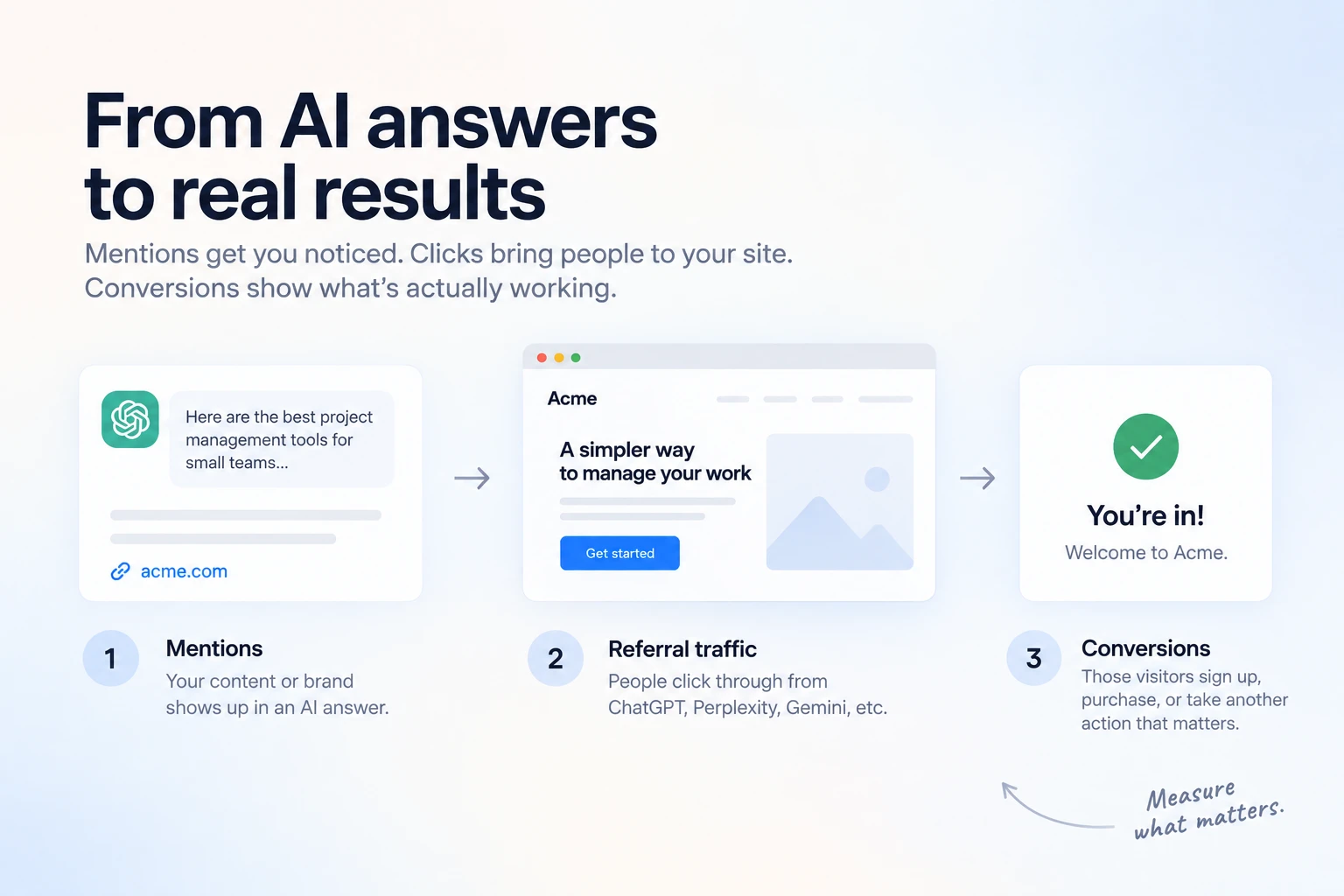
Here’s the part that gets skipped in most guides: getting mentioned by ChatGPT or cited by Perplexity is not the same thing as getting a visitor, and getting a visitor is not the same thing as getting a conversion.
A lot of the current AEO/GEO tooling market measures mentions: how often a brand shows up in AI-generated answers, for which prompts, compared to competitors. That’s useful for understanding visibility, but a mention with no click behind it, or a click with no signup or purchase behind it, doesn’t tell you whether the work is paying off.
The honest hierarchy looks like this:
- Mentions — your content or brand shows up in an AI-generated answer. Visible with mention-tracking tools.
- Referral traffic — someone clicks through from that answer to your site. Visible in GA4 if the referral is identifiable, which isn’t guaranteed for every assistant.
- Conversions — that visitor does something you actually care about: a signup, a purchase, a demo request. This is the step most AEO/GEO reporting doesn’t reach, because it requires connecting the AI-referral visit to what happened afterward on your own site.
A brand can rank well on mention trackers and still not know whether that visibility is contributing anything to the business. That gap is the actual reason AEO and GEO measurement matters more than the definitions.
How to Know If Your AEO/GEO Work Is Actually Working
A few practical checks, in rough order of how much they tell you:
- Check whether AI referrals are identifiable in your analytics at all. Not every assistant sends a clean, identifiable referrer, so this is worth confirming before assuming your current setup is capturing everything.
- Separate AI referral traffic from the rest of organic, don’t lump it in. If identifiable ChatGPT and Perplexity referrals aren’t separated from the rest of your reporting, you can’t evaluate that traffic on its own.
- Track what that traffic does, not just that it arrived. A session from an AI referral that never converts tells a different story than one that does, and averaging them together hides which one is actually true.
- Attribute conversions back to the page that was cited or clicked through from. If you can see that a specific article or page is the one AI assistants keep citing, and that page is also associated with signups or purchases, that’s a much stronger signal than a mention count.
This is the exact gap SEOConversion is built to close, tracking organic and identifiable AI-assistant conversions separately from each other and from paid or direct traffic, and tying conversions back to the landing page associated with that search session. More detail on the mechanics is in How to Track ChatGPT, Perplexity & Gemini Conversions, Not Just Mentions.
Practical Steps to Start with AEO/GEO
- Audit your existing content for question-and-answer structure. Pages that already answer a specific question clearly and early are the easiest to adapt.
- Use relevant structured data where it accurately describes the content, rather than adding schema purely for AEO/GEO.
- Check which of your pages are already being cited by AI assistants. Ask ChatGPT and Perplexity questions your target customers would ask, and see what they cite.
- Set up separate tracking for AI referral traffic before investing heavily in AEO/GEO content, so you have a baseline to measure against once you do.
- Prioritize pages close to conversion, such as comparison, product and pricing pages, alongside informational content that answers the questions your audience is actually asking.
Mentions tell you you’re visible. Referral traffic tells you people clicked. Conversions tell you what happened next.
See how identifiable AI referrals can be tracked through to conversions and value in AI conversion tracking.
FAQ
Is GEO just a rebrand of SEO?
No, but it’s not a replacement for it either. Traditional SEO still governs how you rank in classic search results, which remains most of the traffic for most sites today. GEO addresses a separate and growing surface, AI-generated answers, that classic SEO tactics don’t fully cover on their own.
Do I need a separate content strategy for AEO/GEO?
Not necessarily a separate one. Content that’s clearly structured, directly answers a specific question, and is well-supported by evidence tends to perform across traditional SEO, AEO, and GEO at once. The separate strategy usually needed isn’t content, it’s measurement: knowing which surface a visit and a conversion actually came from.
How do I know if ChatGPT or Perplexity is sending me traffic?
Check your analytics referral sources for chat.openai.com, chatgpt.com, perplexity.ai, and similar domains. Some AI visits may appear as Direct when no identifiable referral or tracking signal is available.
Is mention tracking worth paying for?
It depends on what decision it’s meant to inform. Mention tracking is useful for understanding visibility and competitive positioning. It doesn’t tell you whether that visibility is converting, which is a different question that needs traffic and conversion data, not just mention data.
Mentions get you noticed. Conversions show what's working.
SEOConversion tracks identifiable AI referral traffic from ChatGPT, Perplexity and Gemini through to conversions and value, not just how often you show up in an answer.
Start free