
AI Search vs Traditional SEO: What Actually Changes for Measurement
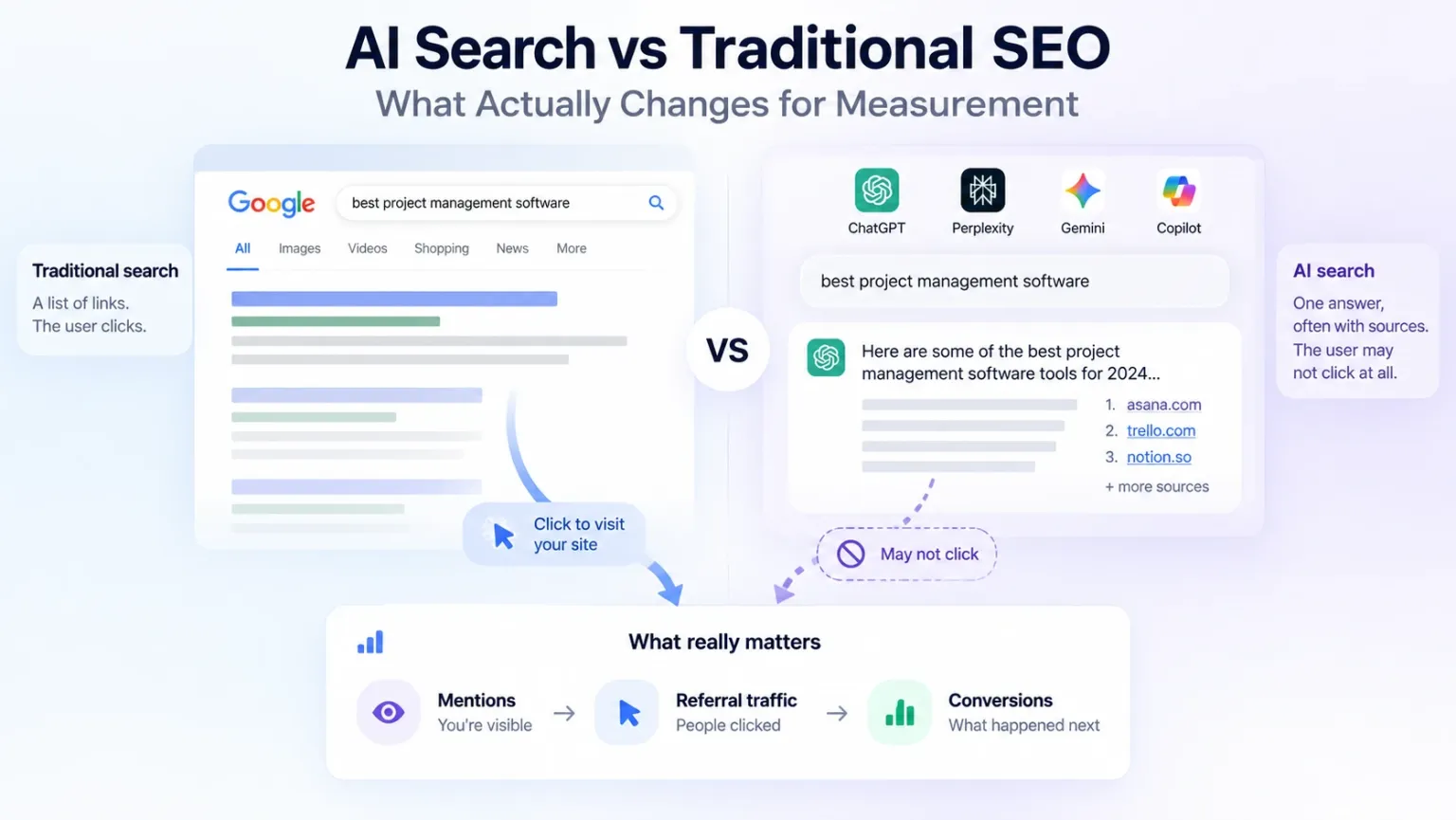
Traditional search sends someone to a results page. They scan the links and click one. AI search works differently. Tools like ChatGPT, Perplexity, Gemini, and Copilot often skip that step. The assistant reads across several sources and writes one answer. The user may never see a list of links at all.
This is not just a theoretical difference. If AI search works differently, your content strategy has to change. So does the way you measure whether it worked.
Traditional SEO vs AI Search, Side by Side
| Traditional search | AI search | |
|---|---|---|
| Optimizes for | Ranking position | Getting selected as a source in an AI generated answer |
| What the user sees | A ranked list of links and snippets | A written answer, often with cited or linked sources |
| Click behavior | The user generally clicks through to access the page | The user may get an answer without clicking |
| Referral data | Search referrals are generally identifiable | Referral signals can vary and may be absent |
| Content considerations | Relevance, authority, technical accessibility | Clear answers, structured information, authoritative sources |
| Visibility signal | Ranking in search results | Being mentioned, cited, or linked in AI answers |
| Business signal | Organic conversions | Conversions from identifiable AI referrals |
These two aren’t in competition for budget. The same page can contribute to visibility in both. Clear structure, useful information, and authority remain relevant, but the way that visibility appears and gets measured is different.
What Stays the Same
Clear, authoritative content remains useful across both traditional search and AI search. Structure still matters too. Headings and short, direct sections also make information easier to navigate and understand across different search experiences. Citations, links, and mentions elsewhere can also contribute to a site’s authority and visibility across different search experiences.
What Changes
Structured data still helps clarify content for search engines. Some AI platforms may use similar signals too, though this isn’t confirmed across every assistant.
A direct answer near the top of the page makes the information easier to extract and understand, whether the reader is a person, a search engine, or an AI system.
The click is no longer guaranteed. A page can be the source behind an AI answer and still get zero traffic from it. Visibility and traffic are two different signals now.
Why AI Search Content Isn’t the Same as AI Search Results
This is the part most comparisons skip. A mention in an AI answer is a different thing from a visit to your site. A visit is a different thing from a conversion.
The real chain looks like this:
- Mentions. Your content or brand shows up in an AI answer.
- Referral traffic. Someone clicks through to your site. Some assistants send no clean referrer at all, so a real visit can show up in your analytics simply as Direct traffic. SEOConversion doesn’t pull a signal out of nothing here. When an identifiable AI referral or supported UTM signal is present, it can classify that session as AI traffic. Without one, the visit remains Direct.
- Conversions. That visitor does something you actually care about, and it matters whether that’s a real transaction or an estimated value, like a signup or a demo request.
A brand can get cited by ChatGPT and Perplexity constantly and still have no idea if that visibility helps the business. That gap is the real reason this comparison matters, more than the definitions do.
How to Know If AI Search Is Actually Contributing
- Confirm that AI referrals show up in your analytics at all, before you assume your current setup catches everything.
- Separate that traffic from the rest of organic, rather than folding it in.
- Track what that traffic actually does, not just that it arrived. Referral traffic becomes much more useful when you can see which visits result in conversions.
- Attribute conversions back to the page associated with that search session, and keep a real transaction separate from an estimated conversion value.
Practical Steps
- Audit your existing top pages for whether they already answer a specific question clearly and early. This is the easiest fix for both traditional and AI search.
- Check your structured data where it accurately describes the content, rather than adding schema for its own sake.
- Ask ChatGPT and Perplexity the questions your customers would ask, and see what gets cited.
- Set up separate tracking for AI referral traffic before you invest heavily in this content, so you have a baseline to compare against.
- Treat “Direct traffic went up” as a starting point, not proof of AI search impact. It’s too imprecise on its own.
Mentions tell you you’re visible. Referral traffic tells you people clicked. Conversions tell you what happened next.
See how identifiable AI referrals can be tracked through to conversions and value in AI conversion tracking.
FAQ
Is AI search replacing traditional SEO?
AI search adds another discovery surface rather than making traditional search irrelevant. People can now discover a brand through a search results page, an AI generated answer, or both. That makes it useful to measure the two channels separately.
Do I need different content for AI search than for SEO?
You don't necessarily need two separate versions of the same content. Strong pages can serve both traditional search and AI discovery, although the way visibility is earned and measured differs.
How do I know if ChatGPT or Perplexity is sending me traffic?
Check your referral sources for chatgpt.com, perplexity.ai, and similar domains. Some AI visits can appear as Direct when there’s no identifiable referral.
Does ranking well in AI search guarantee more conversions?
Being cited is a visibility signal, on its own it's not a business signal. Whether it converts depends on the traffic reaching your site and what happens once it does, and that needs traffic and conversion data, not mention data.
Mentions get you noticed. Conversions show what's working.
SEOConversion tracks identifiable AI referral traffic from ChatGPT, Perplexity and Gemini through to conversions and value, not just whether you show up in an answer.
Start free