
Plausible Alternative: Pick by the Limit You Hit, With 2026 Prices


The best Plausible alternative depends on which Plausible limit you hit. For the same simple, cookieless dashboard from another vendor, use Fathom or Simple Analytics; for a free option, Umami (free cloud tier or self-hosted) or Cloudflare Web Analytics; for deeper reports, Matomo; for product analytics, PostHog. If what you are missing is funnels or revenue, check Plausible’s own Business plan before you move.
This guide sorts the alternatives by reason for leaving, gives current prices checked on each vendor’s pricing page on October 7, 2026, and covers three things the popular lists skip: why Plausible’s revenue attribution misses buyers who come back on another day (and which tools share that limit), where those lists contradict the vendors, and what to export before you cancel.
Plausible alternatives at a glance
| Tool | Best for | Free option | Self-host | Cookies |
|---|---|---|---|---|
| Fathom | The same one-page idea from another vendor | 7-day trial only | No | None |
| Simple Analytics | Strict data minimalism, EU hosting | Free plan: 5 sites, 1 month of history | No | None |
| Umami | Free cloud tier or free self-hosting | Hobby: 100K events, 1 site | Yes (MIT license) | None |
| Pirsch | More filtering, German hosting | Trial | Enterprise only | None |
| Cloudflare Web Analytics | Basic numbers at zero cost | Free | No | None |
| Matomo | A full Google Analytics replacement | On-Premise is free software | Yes | By default; cookieless mode available |
| Piwik PRO | Regulated companies needing consent and tag management | Trial | Hosting options | Configurable |
| PostHog | Software products: funnels, replay, flags | 1M analytics events a month | Yes | By default; cookieless mode available |
| Google Analytics 4 | Google Ads and BigQuery users | Free | No | Yes, consent needed in the EU |
Why people look for a Plausible alternative
Plausible is good at what it does: one page of traffic, sources, pages and goals, no cookies, no personal data. People leave for a short list of reasons, and each one points to a different replacement.
- No free plan. According to Plausible’s pricing, Cloud starts with a 30-day trial, then Starter at $9, Growth at $14 or Business at $19 per month for up to 10k monthly pageviews.
- Price grows with traffic. Pageviews and custom events both count toward the tier, so instrumenting more clicks moves you up a tier just like more traffic does.
- Key features sit on Business. Funnels, user journeys, ecommerce revenue attribution, custom properties, the Stats API and the Looker Studio connector are Business and Enterprise features. Starter is also limited to one site.
- The free self-hosted edition is cut down. The Community Edition page lists what it leaves out: funnels, user journeys, ecommerce revenue goals, SSO and the Sites API. It ships long-term releases twice a year, and you run ClickHouse and Postgres yourself.
- The questions outgrow one page. Plausible does not build user profiles, so it cannot answer what one person did across sessions, which is what product teams need.
Pick a Plausible alternative by the limit you hit
Start from the reason you are leaving. Most people want Plausible’s approach with one thing fixed, not a different kind of tool.
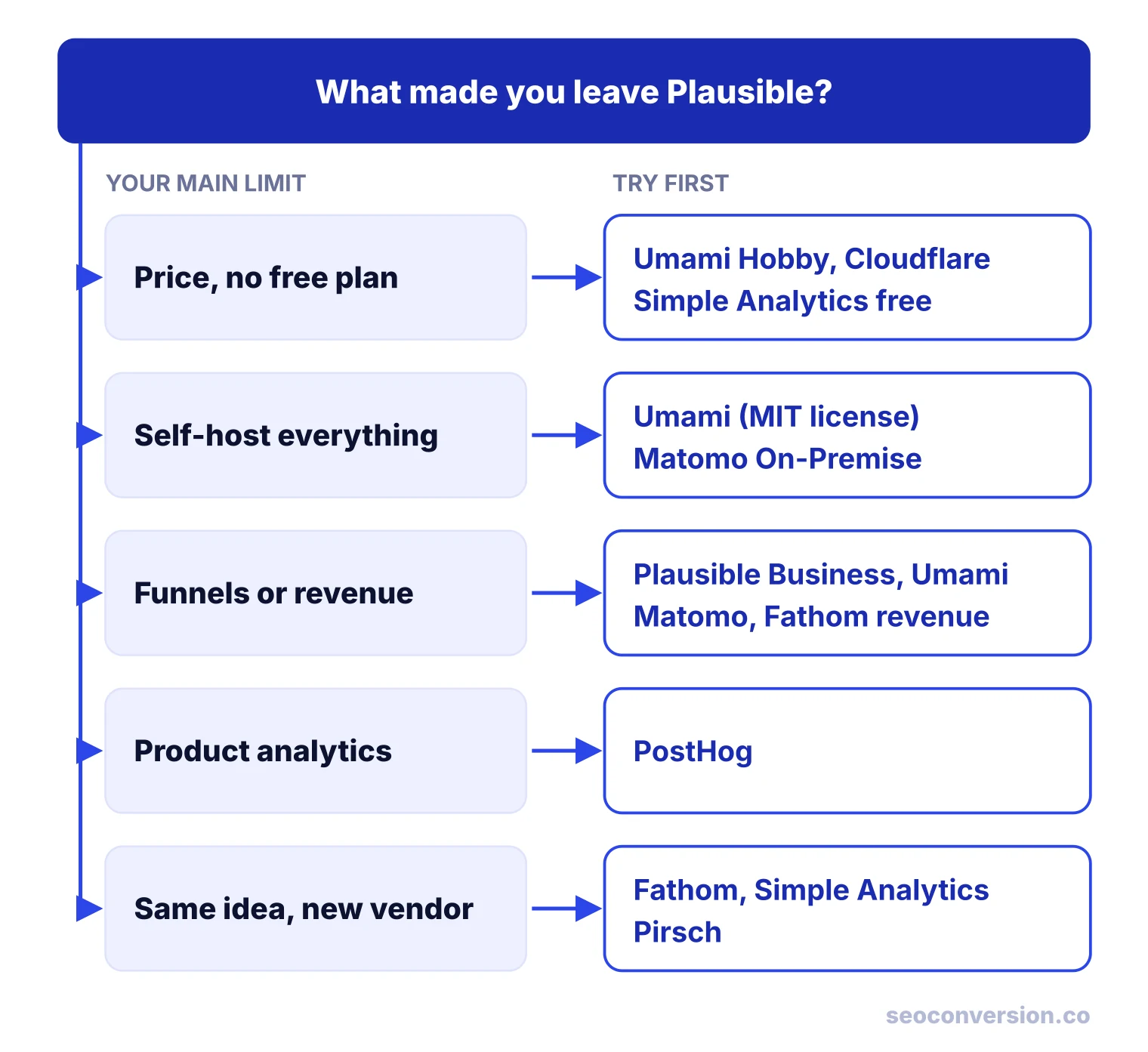
Same idea, different vendor: Fathom, Simple Analytics, Pirsch
Fathom is the closest match in spirit: one dashboard, no cookies, and hosted only. Its pricing page starts at $15 a month for up to 100,000 pageviews and $60 for up to 1,000,000, with 50 sites, event and revenue tracking, UTM tracking, bot filtering and the API on every plan. The trial is 7 days and needs a card. Because 50 sites are included from the first tier, Fathom is often cheaper than Plausible for agencies and busy sites, and pricier for one small site.
Simple Analytics takes data minimalism furthest and hosts in the EU. Its pricing page lists $20 a month at 100k pageviews for one user (extra users cost $20 each) and a free plan for hobby sites: 1 user, 5 websites, the latest month of history and a required badge.
Pirsch is a smaller German tool: cookie-free, with custom events, goals, a server-side API and more filtering than Plausible. Funnels and revenue are on its higher plan. Check its current tiers before you compare, because the lists we read quote it loosely.
Free Plausible alternatives
- Umami Hobby: per Umami’s pricing, $0 for up to 100K events a month, 1 website and 6 months of retention, with funnels, retention, goals, journeys and revenue reports included.
- Cloudflare Web Analytics: free and cookie-free, but the Cloudflare FAQ says custom events are “not yet” supported, data is kept for six months, and only the last 7 days are unsampled before data is aggregated to about 10%. Good for a gauge, not for conversions.
- Simple Analytics free plan: fine for side projects that only need the last month.
- PostHog: its pricing page includes 1M analytics events and 5K session replays a month for free, no card needed. Built for apps more than content sites.
- Google Analytics 4: free and the most complete, at the cost of cookies, consent banners in the EU and a steep interface. Our GA4 alternative guide covers that trade from the other side.
Self-hosting without the missing features: Umami, Matomo
If you self-host Plausible CE and miss funnels or revenue, Umami is open source under the MIT license, its self-hosted version includes funnel, retention and journey reports, and it runs on Postgres, a lighter stack than ClickHouse. Matomo On-Premise is free software with goals, ecommerce and a full report set; funnels, heatmaps and session recordings are paid plugins on the self-hosted version. Matomo uses cookies by default, so turn on its cookieless setting if you want to keep a banner-free setup, at some loss of returning-visitor detail. Our self-hosted analytics guide covers server sizing and the upkeep both need.
More depth, still privacy-minded: Matomo Cloud, Piwik PRO
Matomo Cloud gives you the same platform without the server, starting at 29 per month (excluding tax) for 50,000 hits on Matomo’s pricing page. Piwik PRO adds tag management, consent tools and hosting choices for regulated industries such as health and finance. Both have a learning curve closer to GA4 than to Plausible.
Product analytics: PostHog
PostHog is less an alternative than the next tool: funnels, retention, session replay, feature flags and experiments tied to people in your product. Many teams keep a light tool on the marketing site and PostHog in the app. Our PostHog vs Plausible comparison has a cost example for both.
Revenue attribution
One of the top results for this search is a forum thread asking for a Plausible alternative “if you need revenue attribution”. Before you move for that reason, note two things: Plausible Business already has revenue goals, and the limit most people run into is not the plan but how cookieless tools count visitors. The section after the price table explains it. Newer “revenue-first” tools that sync with Stripe or other payment providers generally need a persistent visitor ID to link a sale to an earlier visit, so read their consent notes before you assume their attribution is cookieless.
What each alternative costs at 100,000 pageviews
Entry prices mislead because every tool here bills on volume. This table uses each vendor’s pricing page on October 7, 2026, for one site with about 100,000 pageviews a month. Plausible does not print its higher tiers in its page text (they sit behind a slider), so read its price on the pricing slider at your own volume.
| Tool | Monthly price near 100k pageviews | What to watch |
|---|---|---|
| Plausible | From $9 (Starter) to $19 (Business) at 10k; higher at 100k, see slider | Custom events count toward the tier |
| Fathom | $15 (up to 100,000 pageviews, 50 sites) | 7-day trial, card required |
| Simple Analytics | $20 (100k pageviews, 1 user) | $20 per extra user |
| Umami Cloud | $0 on Hobby up to 100K events; Pro $20 with 1 million events | Hobby is 1 site, 6 months of data |
| PostHog | $0 within 1M analytics events | Autocapture can use events fast |
| Cloudflare Web Analytics | $0 | No custom events |
| Matomo Cloud | From 29 excl. tax at 50,000 hits; more at 100k | Hits include events, not only pageviews |
| Self-hosted Umami, Matomo or Plausible CE | $0 license plus your server | Your time for updates and backups |
Why Plausible revenue misses buyers who come back another day
Plausible’s data policy explains how it counts visitors without cookies: it hashes a daily salt with the site domain, IP address and user agent, and the salt is rotated and deleted every 24 hours. That is what keeps it private, and it means the same person gets a new identifier each day. Its revenue tracking docs say revenue is credited to the source that started the session (payment processors such as PayPal, Stripe and Paddle are excluded as referrers). Put together: a buyer who found you on Google on Monday and came back by typing your URL on Thursday is a Direct sale.
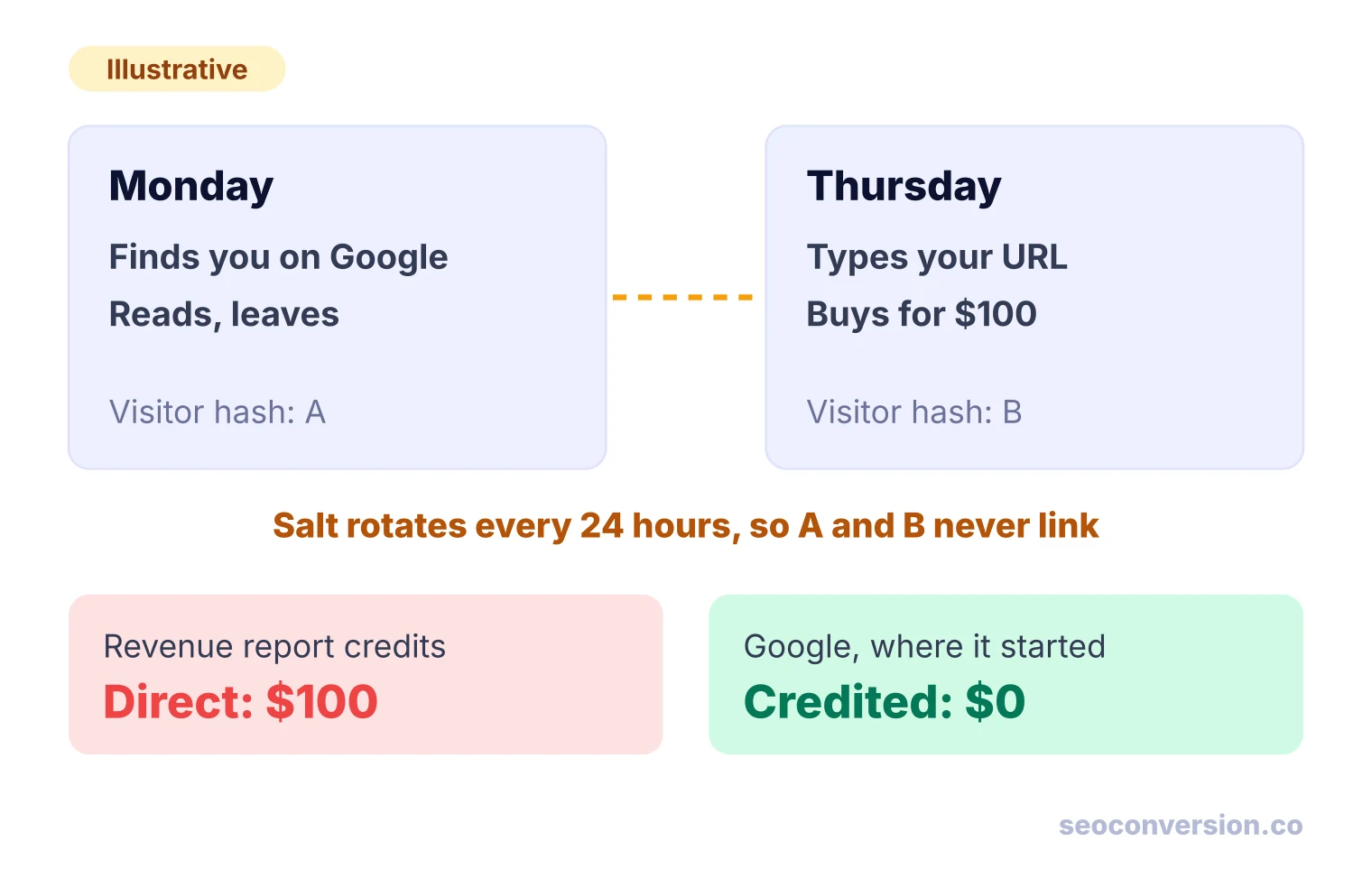
Worked example: how much organic revenue goes to Direct
Illustrative numbers for one month of a store with a $100 average order:
- Plausible shows 300 orders and $30,000 in revenue: Google 90 orders ($9,000), Direct 120 orders ($12,000), everything else 90 orders ($9,000).
- A “how did you first find us?” question at checkout shows that 50 of the 120 Direct buyers first came from Google on an earlier day.
The dashboard credits Google with $9,000 of the $14,000 it started, so $5,000, or about 36%, sits in Direct. Your real share depends on how long people take to buy; the longer the cycle, the bigger the gap.
Where the top Plausible alternative lists contradict the vendors
We read every ranking page and checked their claims against the vendors’ own pages on October 7, 2026. Several are out of date or disagree with each other:
| Claim in the lists | What the vendor says now |
|---|---|
| Fathom has a 30-day trial | 7-day trial, card required |
| Fathom costs $79 (or about $55) at 1M pageviews | $60 a month for up to 1,000,000 pageviews |
| Umami has no funnels | Funnels, retention and journeys are listed on every plan, including the free Hobby plan |
| Umami Cloud costs $9 for 100K events, or its free tier covers 3 sites | Hobby is free for 100K events and 1 website; Pro is $20 |
| Simple Analytics costs $9 at 100K pageviews, or has no free tier | $20 at 100k pageviews; a free plan exists (5 sites, 1 month of history) |
| Plausible has no funnels | Funnels are on Business and above, not in the Community Edition |
The lesson: analytics pricing changes often, and many of these lists are written by vendors in the same market. Price your own volume on the vendor’s page the day you decide.
Do you still need a cookie banner?
Plausible, Fathom, Simple Analytics, Umami, Pirsch and Cloudflare Web Analytics set no cookies by default, which is why most site owners run them without an analytics consent prompt. Matomo and PostHog use cookies unless you switch to their cookieless modes, and GA4 uses cookies. Cookies are not the only test, though: privacy law also looks at what data you collect and where it goes, and the rules differ between the EU and US states. See cookie banner requirements and confirm with your own counsel.
How to switch from Plausible without losing data
- Write down the questions Plausible could not answer. If you cannot name them, you may not need to switch.
- Install the new tool next to Plausible for 2 to 4 weeks. Cookieless tools count visitors in slightly different ways, so learn the new baseline before the old one is gone.
- Recreate every goal and event. List your Plausible goals, custom events and revenue goals, rebuild them, then test each one with a real form submit or test order.
- Export the full history, not the dashboard view. Per Plausible’s export docs, dashboard exports are a ZIP of CSVs capped at 300 entries per file and 100 for page reports. Use the export in site settings for all stats. Dashboard exports and the Stats API stop working without an active trial or subscription, so do it before you cancel.
- Do not count on an import. Check whether the new tool imports Plausible data; if not, keep the CSVs as your historical record and annotate the switch date in your reports.
- Update your privacy policy and remove the old script, including any proxy you set up for it.
- Check page weight if the new script is heavier. Our lightweight analytics test measured 11 scripts.
When to stay with Plausible
- Your questions are about traffic: visitors, sources, pages, goal completions.
- What you miss is funnels or revenue, and upgrading to Business costs less than a migration.
- You run a blog, docs or marketing site, not a product that needs user-level data.
- Your visitors value privacy and the simple dashboard is part of why you check it at all.
Compare alternatives on conversions and value, not dashboards
Every tool above shows visits and sources. The question that decides budget is different: which landing pages and channels produce leads and sales, and what are they worth? When you trial a replacement, test it on that. Can it count your real conversions (forms, calls, purchases)? Can you put a value on each one, as in how to calculate conversion value? Does it report that value by landing page and by channel, including AI assistants?
If that is the job, SEOConversion is built for it: a cookieless, first-party tracker that reports conversions and their value from Google, Bing and AI assistants such as ChatGPT and Perplexity by landing page, and reads purchases from the dataLayer on Shopify, WooCommerce and Webflow. It is not a general traffic dashboard, so many sites run it alongside one. The SEO conversion tracking guide explains the method in any tool.
FAQ
What is a Plausible alternative?
It is any web analytics tool you can use instead of Plausible Analytics. Most people mean a tool with the same privacy-first, cookieless approach, such as Fathom, Simple Analytics, Umami or Pirsch. Others mean a deeper tool that still respects privacy, such as Matomo, or a product analytics suite such as PostHog.
Is Plausible free to use?
Plausible Cloud has no free plan, only a 30-day trial without a card; Starter costs $9 a month for up to 10k monthly pageviews. The self-hosted Community Edition is free under the AGPLv3 license, but you run the server, and it leaves out funnels, user journeys and ecommerce revenue goals.
How much does Plausible Analytics cost?
At up to 10k monthly pageviews, Starter is $9, Growth $14 and Business $19 per month. The price rises with volume, and custom events count toward the limit together with pageviews. Funnels, revenue goals, custom properties and the Stats API are only on Business and above.
What is the best free web analytics tool?
For a simple site, Cloudflare Web Analytics and the free Umami Hobby plan cost nothing and need no cookies. Google Analytics 4 is the most complete free option but brings cookies and consent work. For an app, PostHog includes 1M analytics events a month for free.
Is Plausible better than Google Analytics?
It is simpler and lighter, works without cookies and shows everything on one page. Google Analytics 4 is free and goes much further on attribution, audiences, Google Ads and raw data export. Choose by the questions you ask every week, not by feature count.
What is replacing Google Analytics?
Nothing replaces it for everyone. Small sites often move to cookieless tools such as Plausible, Fathom, Simple Analytics or Umami; teams that need GA-level reports move to Matomo or Piwik PRO; software teams add PostHog. Many keep GA4 next to a lighter tool.
Know which pages earn revenue, whatever analytics you pick.
SEOConversion is a cookieless tracker that reports conversions and their value from Google, Bing and AI assistants by landing page. Try it free for 7 days, no credit card.
Start free