
AI Search Statistics 2026: Users, Clicks, Traffic and Conversions

The most important AI search statistics in 2026: ChatGPT has more than 900 million weekly active users (OpenAI, February 2026), Google’s AI Mode has passed 1 billion monthly users (Google, July 2026), and 44% of U.S. adults have used ChatGPT (Pew, June 2026). Yet Google still holds 89.94% of search engine market share, and AI platforms sent about 770.7 million referral visits a month to websites, a small slice of search traffic.
Every number below links to the study or company report it comes from, with its date. No figure is copied from a roundup. After the numbers, you will find where the sources contradict each other, a checklist for reading any AI search statistic, and a worked example that turns these trends into your own numbers.
AI Search Statistics at a Glance
| Statistic | Figure | Source and date |
|---|---|---|
| ChatGPT weekly active users | More than 900 million | OpenAI, Feb 27, 2026 |
| Google AI Mode monthly active users | More than 1 billion | Google, Jul 22, 2026 |
| Gemini app monthly active users | 950 million | Google, Jul 22, 2026 |
| U.S. adults who have used ChatGPT | 44% | Pew, survey Feb 2026 |
| U.S. adults who use chatbots to search for information | About 4 in 10 | Pew, survey Feb 2026 |
| Google worldwide search engine share | 89.94% | Statcounter, Sep 2026 |
| Google visits with a result click, AI summary vs none | 8% vs 15% | Pew, data Mar 2025 |
| Position-one CTR drop when an AI Overview shows | 58% lower | Ahrefs, Feb 2026 |
| AI referral visits to websites per month, worldwide | 770.7 million (+117.4% YoY) | Similarweb, Jun 2025 to May 2026 |
| AI traffic conversion vs non-AI traffic, U.S. retail | 42% better (Mar 2026) | Adobe, Apr 2026 |
| AI-cited URLs that rank in Google’s top 10 for the prompt | 12% | Ahrefs, Aug 2025 |
How Many People Use AI Search?
ChatGPT
On February 27, 2026, OpenAI said ChatGPT has more than 900 million weekly active users and more than 50 million consumer subscribers. That is the last user count OpenAI itself has published as of this writing. Press reports in September 2026 claimed OpenAI’s products had crossed a higher threshold, but we found no OpenAI page confirming a new ChatGPT figure, so we use 900 million.
What do those users do? OpenAI’s September 2025 study of 1.5 million conversations, published when ChatGPT had 700 million weekly users, found that 49% of messages are “Asking” (seeking information or advice), 40% are “Doing” (drafting, planning, coding) and 11% are “Expressing.” About 30% of consumer use is work-related. The “Asking” half is the part that competes with search.
Adoption in the U.S.
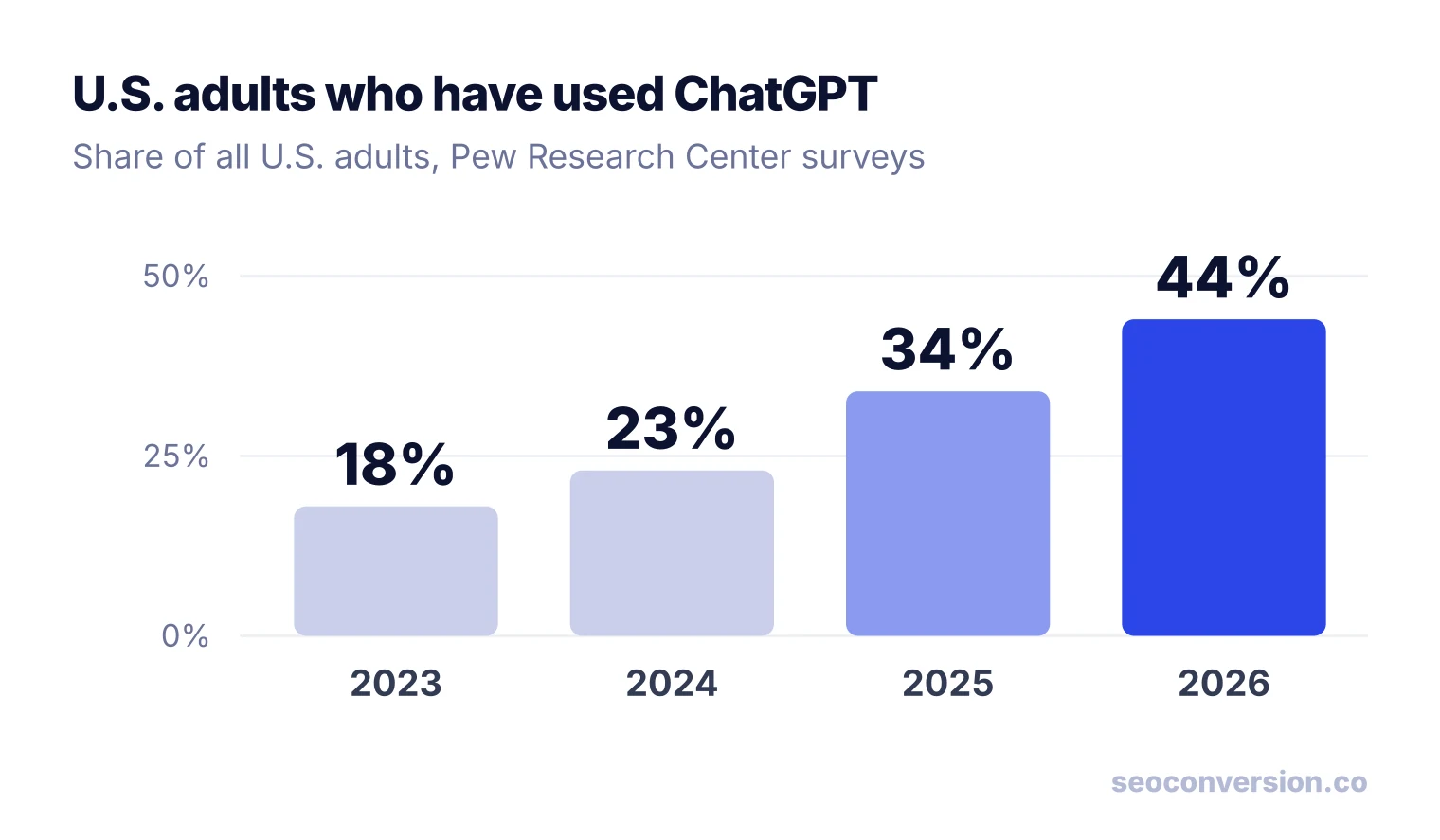
Pew Research Center’s June 17, 2026 report (survey of 5,119 U.S. adults, February 17 to 23, 2026) found that about half of U.S. adults now use AI chatbots, up from a third in 2024, and about a quarter use them daily. The share who have used ChatGPT went from 18% in 2023 to 23% in 2024, 34% in 2025 and 44% in 2026 (Pew notes the 2026 question also asked about other chatbots, which may account for some of the last jump). About four in ten adults say they use chatbots to search for information.
ChatGPT is not the only assistant people use. In the same Pew survey, 24% of U.S. adults said they use Gemini, 17% Copilot, 14% Meta AI and 6% Claude.
Gemini app
Google reported 450 million monthly active users for the Gemini app in July 2025 and 950 million in July 2026, with daily active users tripling over that year.
AI Inside Google Search
For most people, “AI search” means the AI answer at the top of Google, not a separate chatbot. Google’s own numbers:
- AI Overviews: more than 2 billion monthly users across more than 200 countries and territories, and over 10% more queries for the types of queries that show them (Google, July 2025).
- AI Mode: over 100 million monthly active users in the U.S. and India in July 2025, then more than 1 billion after its global expansion (Google, July 22, 2026). Google has since brought AI Overviews and AI Mode together into one Search experience.
- How often an AI summary appears: in March 2025, 18% of the Google searches Pew tracked produced one (Pew, July 2025). The share depends heavily on query type and has changed since.
None of this has dented Google’s scale. Google said it sees more than 5 trillion searches a year (May 2025), its Search and other revenue grew 17% year over year in Q2 2026, and Statcounter puts Google at 89.94% of worldwide search engine market share in September 2026, with Bing at 5.29%. If you want the background on the feature itself, read what an AI Overview is.
What AI Answers Do to Clicks
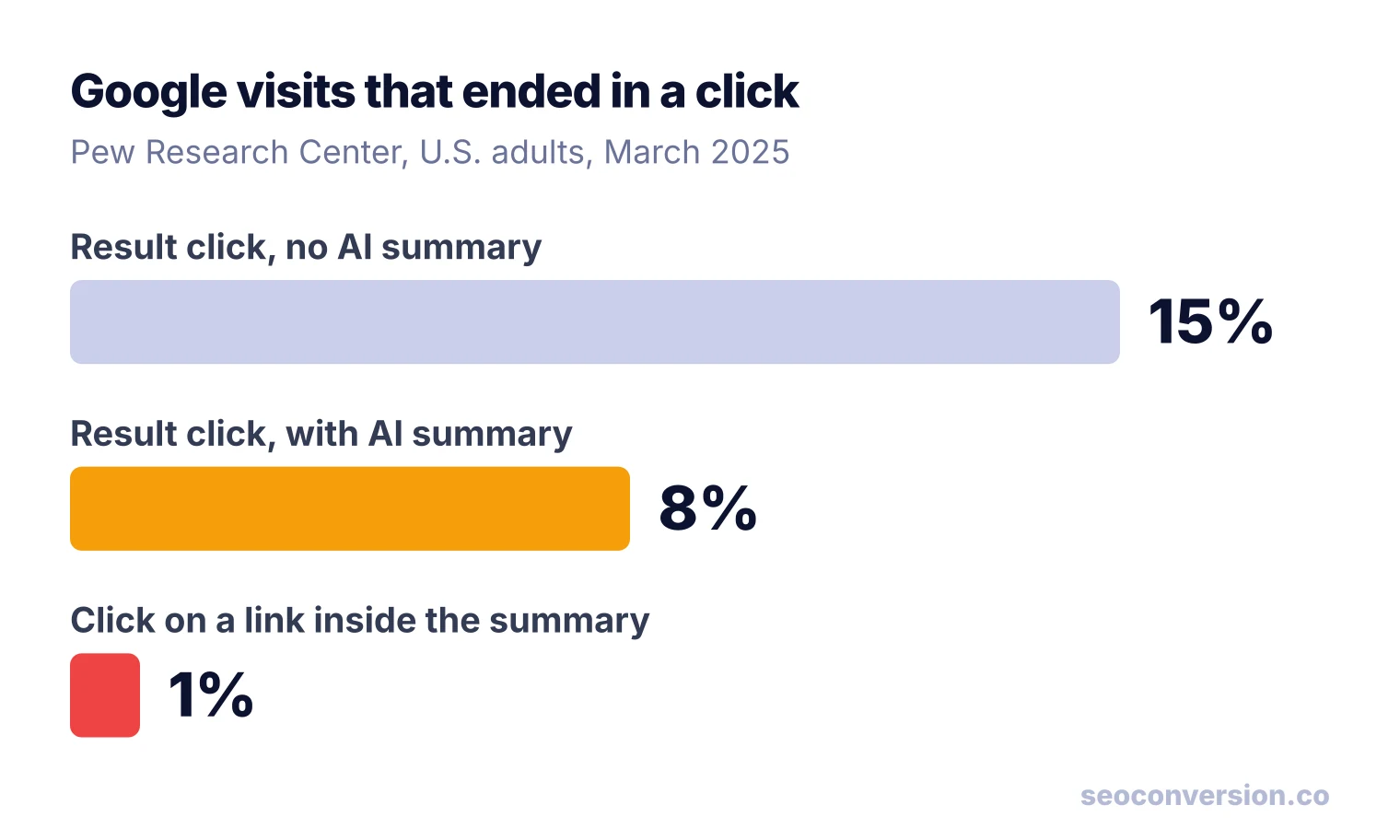
Pew tracked 68,879 real Google searches by 900 U.S. adults in March 2025 (published July 22, 2025). When an AI summary appeared, users clicked a traditional result on 8% of visits. Without one, they clicked on 15%. They clicked a link inside the AI summary on just 1% of visits. Sessions also ended more often: 26% of pages with an AI summary were the last page of the session, versus 16% without one.
Click-through rate data points the same way. Ahrefs compared aggregated Search Console data for 300,000 keywords between December 2023 and December 2025 and found that the top-ranking page gets a 58% lower average click-through rate when an AI Overview is present (February 4, 2026). The drop shrinks lower on the page: about 19.4% at position ten.
Google disagrees with the conclusion people draw from this. Its head of Search wrote on August 6, 2025 that total organic click volume from Google to websites has been “relatively stable” year over year and that average click quality has increased, without publishing figures. Both can be true, as the contradictions section below explains.
How Much Traffic AI Assistants Send to Websites
Similarweb measured an average of 770.7 million referral visits per month from AI platforms worldwide between June 2025 and May 2026 (desktop and mobile web), up 117.4% year over year. ChatGPT accounts for more than 80% of AI referrals to top global domains in its data.
For scale, Google said back in 2021 that Search sends “billions of clicks to websites every day”. Our arithmetic: 770.7 million a month is about 25.7 million a day, roughly 1.3% of 2 billion. The periods and methods differ, so treat that as an order of magnitude, not a market share. Google now also says it sends billions of clicks to websites every week through AI features in Search.
Retail sees the fastest growth
Adobe, which measures more than 1 trillion visits to U.S. retail sites, reports AI-referred traffic growth season by season:
| Period | AI traffic to U.S. retail sites | Source |
|---|---|---|
| Nov to Dec 2025 (holiday season) | +693.4% YoY | Adobe, Jan 7, 2026 |
| Jan to Mar 2026 | +393% YoY | Adobe, Apr 16, 2026 |
| Nov to Dec 2026 (forecast) | +130% YoY | Adobe, Sep 28, 2026 |
Growth rates fall as the base grows. Adobe itself notes that the base of users “remains modest.”
Crawling far outpaces referrals
Cloudflare compares how often each platform crawls pages with how often it sends a visitor back. In July 2025 (published August 29, 2025), the crawl-to-refer ratios were:
| Platform | Crawls per referral, Jan 2025 | Crawls per referral, Jul 2025 |
|---|---|---|
| 3.8 | 5.4 | |
| Perplexity | 54 | 194 |
| OpenAI | 1,217 | 1,091 |
| Anthropic | 286,930 | 38,065 |
Cloudflare also found that training drives nearly 80% of AI bot activity. Most AI crawling feeds models, not answers that link back to you.
Does AI Search Traffic Convert?
This is the number that matters for revenue, and it has flipped. In U.S. retail, Adobe reported on April 16, 2026 that AI traffic converted 42% better than non-AI traffic (paid search, email and other channels) in March 2026, a record. In March 2025, it had converted 38% worse. In March 2026, AI visitors also had a 12% higher engagement rate, spent 48% longer on the site and viewed 13% more pages per visit.
Two caveats. First, this is retail only; B2B and lead-generation sites have no comparable public dataset. Second, Adobe’s own figures for early 2025 differ: its March 17, 2025 release said AI traffic was 9% less likely to convert in February 2025, while the 2026 report says 38% worse for March 2025. The direction (from worse to better) is consistent; single-month gaps are not stable enough to plan on.
Where AI Answers Get Their Sources
- Rankings and citations overlap less than you think. Across 15,000 long-tail prompts, Ahrefs found only 12% of URLs cited by AI assistants rank in Google’s top 10 for the same prompt, and about 80% do not rank in the top 100 at all (August 11, 2025). Perplexity overlapped most (28.6%); ChatGPT (8%), Gemini (8.6%) and Copilot (8.2%) much less.
- Reddit and Wikipedia lead, but they swing. Semrush tracked 230,000 prompts and over 100 million citations from July 14 to October 12, 2025 (published November 10, 2025). Reddit and Wikipedia were still ChatGPT’s two most-cited domains, but Reddit fell from appearing in roughly 60% of ChatGPT responses to about 10% in mid-September, and Wikipedia from about 55% to under 20%. Google AI Mode leaned on LinkedIn, YouTube, Reddit and Google’s own properties; Perplexity on Reddit, LinkedIn, NIH, Microsoft and Google.
The lesson: one model update can reshuffle which domains get cited, so citation shares are snapshots. If citations are your goal, see how to track AI citations.
Where the AI Search Statistics Contradict Each Other
Roundups list these numbers side by side as if they agreed. They often measure different things. Here is how to reconcile the main conflicts:
| Claim A | Claim B | Why both can be true | What to use |
|---|---|---|---|
| Google: total organic clicks “relatively stable” (Aug 2025) | Pew: 8% vs 15% click rate; Ahrefs: 58% lower position-one CTR | Google counts total clicks across all queries, which keep growing. Pew and Ahrefs measure clicks per search on queries with an AI answer. | Expect fewer clicks per informational query; check your own Search Console trend by page type. |
| Reports of 1 billion+ weekly users (Sep 2026) | OpenAI: 900 million+ weekly ChatGPT users (Feb 2026) | The newer figure circulated through press reports about OpenAI’s products overall, not a published OpenAI page on ChatGPT. | Quote 900 million with its date until OpenAI publishes a newer number. |
| Adobe: AI traffic 9% less likely to convert (Feb 2025) | Adobe: AI traffic converted 38% worse (Mar 2025) | Different months and possibly different comparison sets in two separate releases. | Use the trend (worse to better), not a single month. |
| Reddit is the most-cited domain in AI | Reddit fell from ~60% to ~10% of ChatGPT responses | Rankings of domains can hold while their share collapses, and results differ by platform. | Always say which platform and which period. |
How to Read an AI Search Statistic Before You Quote It
Run any number through these six checks. Most bad AI search statistics fail at least one.
- Which measure? Weekly active users (OpenAI), monthly active users (Google) and “have ever used” (Pew) are not comparable. A weekly count is stricter than a monthly one.
- Who measured it, and how? Company disclosures count their own users. Panels (Pew, Similarweb) sample people or devices. Analytics vendors (Adobe) see their clients’ sites. Each has blind spots.
- When? AI search changes quarterly. A 2024 number quoted as current is wrong by default. Note the data period, not just the publish date.
- Where and who? U.S. adults, U.S. retail sites or the worldwide web give very different answers.
- Rate or volume? “+393% growth” on a small base can still be a small number of visits. Ask for the share of total traffic too.
- Can you open the original? If a roundup cites another roundup, go to the primary. If you cannot find one, do not use the number.
Turn AI Search Statistics Into Your Own Numbers
Industry averages tell you the direction. Your analytics tells you whether AI search matters for your site. Three numbers are enough: share of sessions, conversion rate and value per session, for AI referrals compared with organic search.
A site has 50,000 sessions in a month. 20,000 come from organic search and 600 from AI assistants (ChatGPT, Perplexity, Gemini, Copilot, Claude).
Organic search produces 440 conversions (2.2%). AI referrals produce 18 conversions (3.0%). Each conversion is worth $150.
AI share of search and AI sessions: 600 / 20,600 = 2.9%. AI share of their conversions: 18 / 458 = 3.9%.
Value per session: organic $66,000 / 20,000 = $3.30. AI $2,700 / 600 = $4.50.
Conclusion for this site: AI is small in volume but each visit is worth about 36% more, so it is worth tracking by landing page.
Three things distort this calculation:
- Missing referrers. Some assistant apps open links without a referrer, so those visits land in Direct. Your AI share is a floor, not an exact figure. See what direct traffic means.
- Too few conversions. 18 conversions can swing by a third from one month to the next. Compare quarters, not weeks.
- No value on conversions. Without a dollar value, you can only compare rates. Here is how to calculate conversion value.
For the setup, follow the guide to tracking ChatGPT and AI assistant conversions or read AI traffic analytics for the reports to build. SEOConversion does this calculation for you: it identifies AI assistant visits from referrals, attributes conversions and their value to Google, Bing and each assistant at the landing-page level, and leaves visits without a referrer in Direct instead of guessing.
FAQ
How many people use AI search?
OpenAI said in February 2026 that ChatGPT has more than 900 million weekly active users. Google said in July 2026 that AI Mode has passed 1 billion monthly active users and the Gemini app has 950 million. In the U.S., Pew found in February 2026 that 44% of adults have used ChatGPT and about four in ten use chatbots to search for information.
What are the statistics for Google search?
Google said in May 2025 that it sees more than 5 trillion searches a year. Statcounter puts Google at 89.94% of worldwide search engine market share in September 2026, with Bing at 5.29%. Google also reported 17% revenue growth in Search and other in Q2 2026, so AI features have not shrunk the business.
Does AI search traffic convert better than other traffic?
For U.S. retail, Adobe found AI-referred visits converted 42% better than non-AI traffic in March 2026, after converting 38% worse in March 2025. That is one industry and one vendor’s data, and the gap has moved fast. Check your own conversion rate by source before you plan around it.
Is there an AI tool for finding statistics?
Any AI assistant with web search, such as ChatGPT, Perplexity or Gemini, can find statistics for you, but it often cites roundups instead of the original study. Ask it for the primary source, open that source, and check the date, sample and metric before you quote the number.
What is the 30% rule for AI?
There is no recognized “30% rule” in any of the primary AI search sources cited here, and the phrase is used informally for different ideas. If someone quotes one in a plan, ask for the original source and the measurement behind it, the same way you would for any statistic.
How much traffic do AI chatbots send to websites?
Similarweb measured an average of 770.7 million referral visits per month from AI platforms worldwide between June 2025 and May 2026, up 117.4% year over year, with ChatGPT sending more than 80% of AI referrals to top domains. That is still small next to Google Search, which said in 2021 that it sends billions of clicks to websites every day.
Turn AI search statistics into your own conversion numbers.
SEOConversion identifies visits from ChatGPT, Perplexity, Claude, Gemini and Copilot by referral and shows the conversions and value they bring, page by page, next to Google and Bing.
Start free